
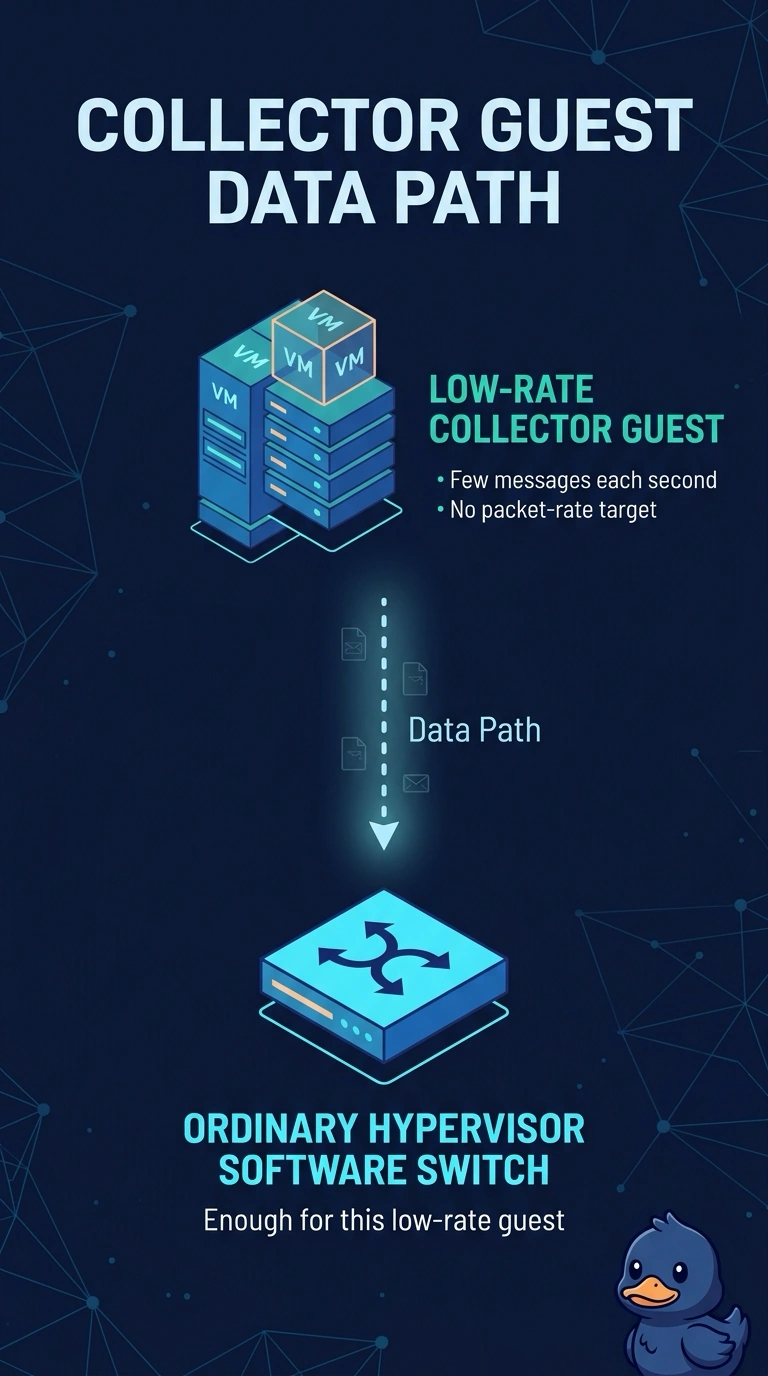
A syslog collector guest on an NFV host emits only a few messages each second and has no packet-rate target. Which data path matches that guest?
Select an answer to reveal the explanation.
Short Explanation
A bicycle does not need the timing gear of a racetrack. You leave this low-rate syslog guest on the ordinary software switch because nothing about its message rate calls for a faster path. SR-IOV, DPDK, and VPP each skip the software switch or move forwarding into user space for a packet rate you do not have.
Full Explanation
SR-IOV, DPDK, and VPP are optimizations for packets per second. SR-IOV gives the guest a virtual function and skips the software switch. DPDK and VPP move forwarding into user space so the kernel path is not the bottleneck. A syslog collector that emits a few messages each second has no such bottleneck. Leaving it on the ordinary hypervisor software switch matches the low rate and keeps the guest simple. SR-IOV, giving the guest a virtual function so packets skip the software switch is the wrong fit because SR-IOV skips the software switch with a virtual function, which is a packet-rate tool this low-rate guest does not need. DPDK, moving the collector's forwarding into user space for a higher packet rate is the wrong fit because DPDK moves forwarding to user space to raise packets per second, and this collector has no packet-rate target. VPP, moving the collector's forwarding into user space off the kernel path is the wrong fit because VPP also moves forwarding to user space for packet rate, which a few syslog messages each second do not require. Exam caveat: Use the normal virtual switch for the stated low-rate collector. Choose direct VF assignment for a supported switch-bypass need and userspace processing when profiling identifies a suitable packet-processing bottleneck. Operational check: Confirm the collector uses the software switch with no virtual function assigned.