
Live broadband gateways keep forwarding, the compute hosts answer, and the VIM API answers, but every new volume attach fails with a storage-backend error. Which fault matches the evidence?
Select an answer to reveal the explanation.
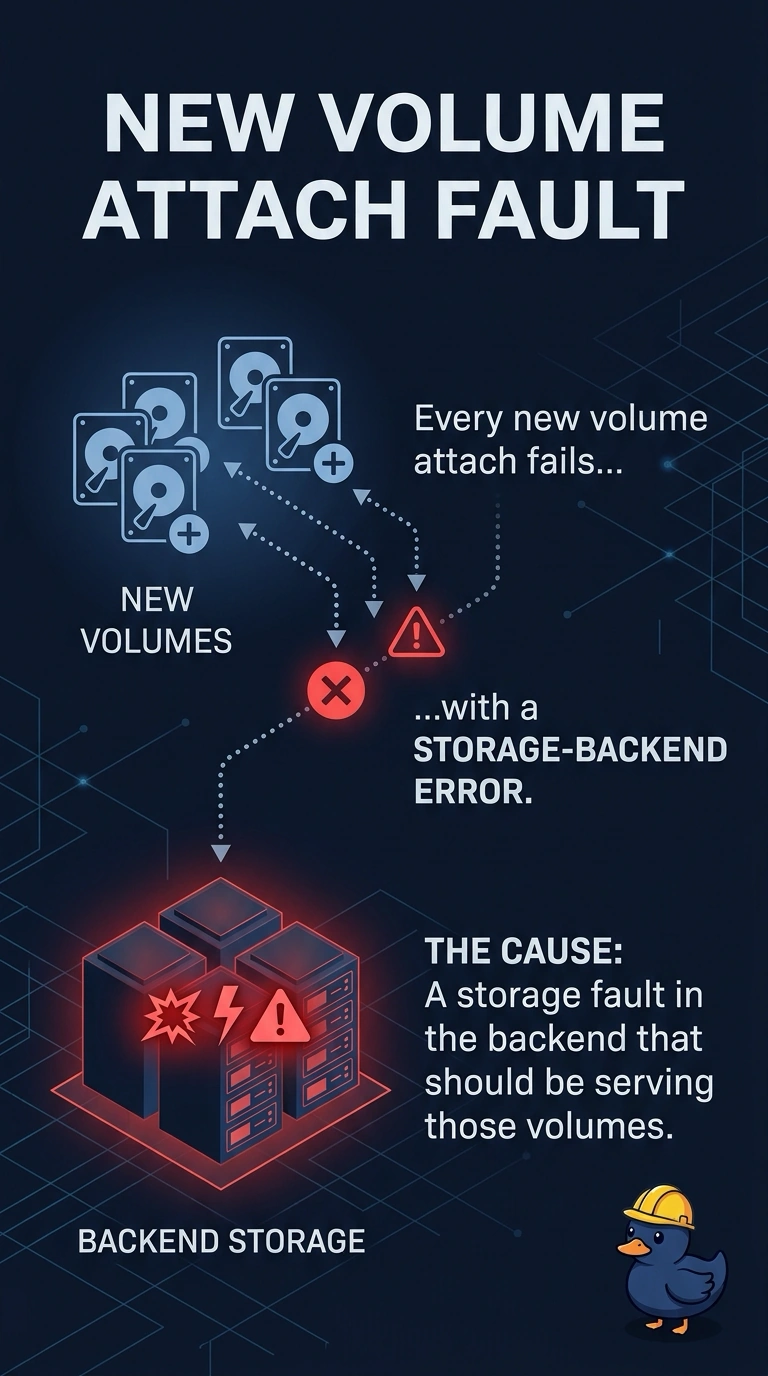
Short Explanation
This is like a pantry door that will not open for a new cook while the cooks already at the stove keep working. You follow the storage-backend error on new attaches, with hosts and the API still answering. A compute outage, a silent VIM API, and a crashed guest each contradict the evidence you already have.
Full Explanation
New volume attaches fail with an error from the storage backend, while compute hosts still answer, the VIM API still answers, and gateways that already have disks keep forwarding. That pattern isolates the fault to storage. A compute fault would remove the hosts. A VIM API fault would stop the controller from answering. A guest fault would show up inside a gateway that is already running, not as a backend error on a new attach. A storage fault in the backend that should be serving those new volumes is the design that meets this requirement. A compute fault that has taken the live gateway hosts fully out of service is the wrong fit because the compute hosts still answer and the live gateways still forward, so the hosts themselves are not the failed layer. A VIM API fault that has stopped the cloud controller from answering calls is the wrong fit because the VIM API still answers the calls, so this is not a controller outage even though the attach result is an error. A guest operating system fault inside gateways that are still forwarding is the wrong fit because the guests that already run are still forwarding, and a storage-backend error on new attaches is not a guest crash. Exam caveat: A guest that cannot boot a new disk can look like a guest problem at first, but the backend error plus healthy live guests means you do not call the VIM down. Operational check: Confirm the storage backend logs the attach error, the compute hosts still report ready, and the VIM API still returns a response for a read-only query.