
A mobile packet gateway already receives frames on an SR-IOV virtual function, so the host software switch is not on the path. The guest still handles every packet through the kernel network stack and cannot keep the rate. The application stays. The gateway supports a DPDK packet-I/O mode, and its assigned VF has a compatible poll-mode driver. Which change addresses the remaining limit?
Select an answer to reveal the explanation.
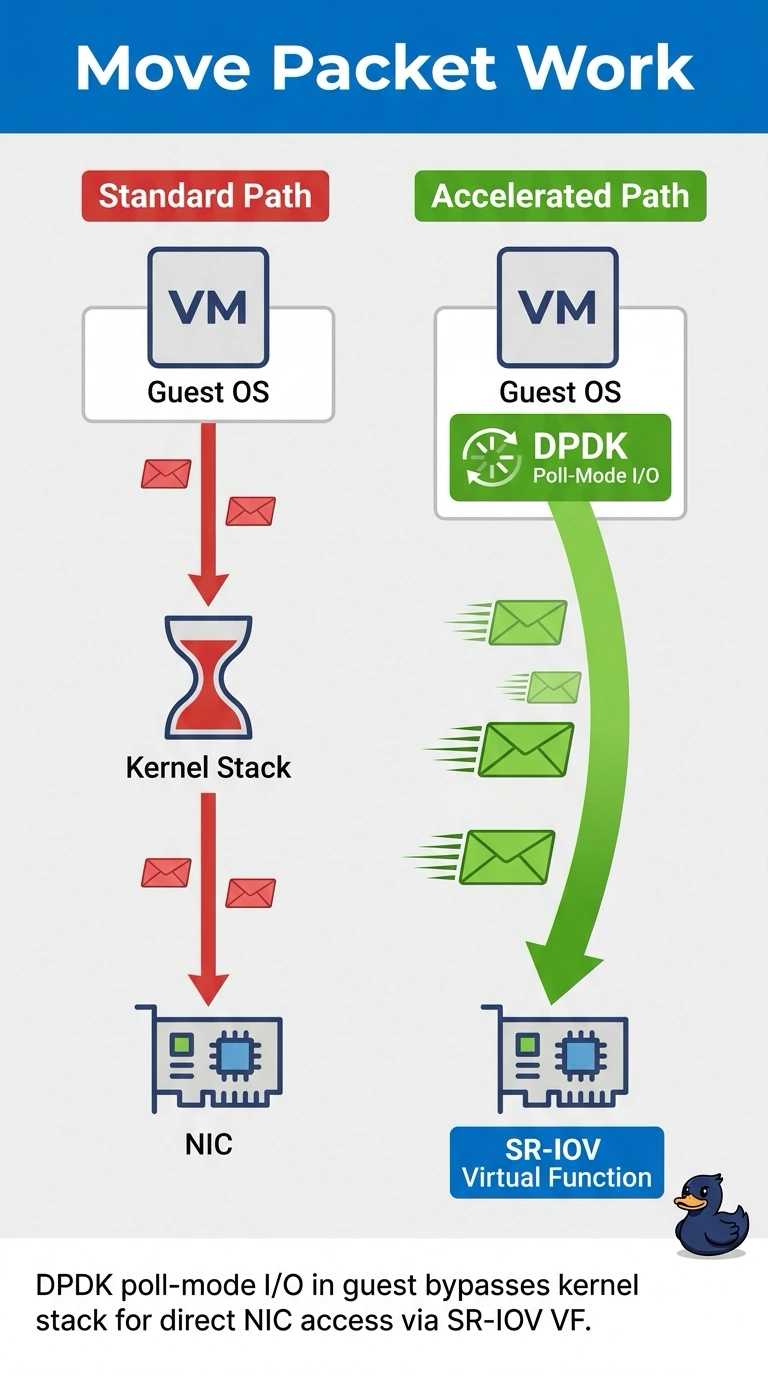
Short Explanation
The package is already at the front desk, and the clerk is still walking each one up the stairs. SR-IOV is delivering frames straight to your guest, and the guest kernel is the stairwell that cannot keep up. Poll-mode drivers let the application take packets without that kernel trip, and the application itself stays.
Full Explanation
SR-IOV already gave the guest a virtual function, so frames skip the host software switch. The remaining bottleneck is the application’s kernel-network-stack I/O path; this does not imply one hardware interrupt per packet. Enabling the application’s supported DPDK mode uses its compatible PMD for userspace packet I/O, bypassing the ordinary kernel networking path. Adding SR-IOV again repeats a step that is done. A separate userspace forwarder graph, the role VPP plays, replaces the forwarder; the stem says the application stays, so a replacement graph is the wrong problem to solve. Slowing the kernel interrupt path deepens the limit instead of removing it. Exam caveat: DPDK is the I/O method, not a second virtual function and not a new forwarder. Operational check: confirm the guest process is bound to poll-mode drivers on the existing virtual function and that the packet rate climbs without a change to the host software switch. The virtual function stays as it is. The change is how the guest pulls packets from that function, not another pass through the host software switch.