
A packet-capture probe guest must take a very high frame rate, and the host software switch drops frames before they reach the guest. The probe is not the fabric forwarder. The NIC and hypervisor support SR-IOV, and the traffic to capture can be delivered directly to the probe’s VF. What removes that drop?
Select an answer to reveal the explanation.
Short Explanation
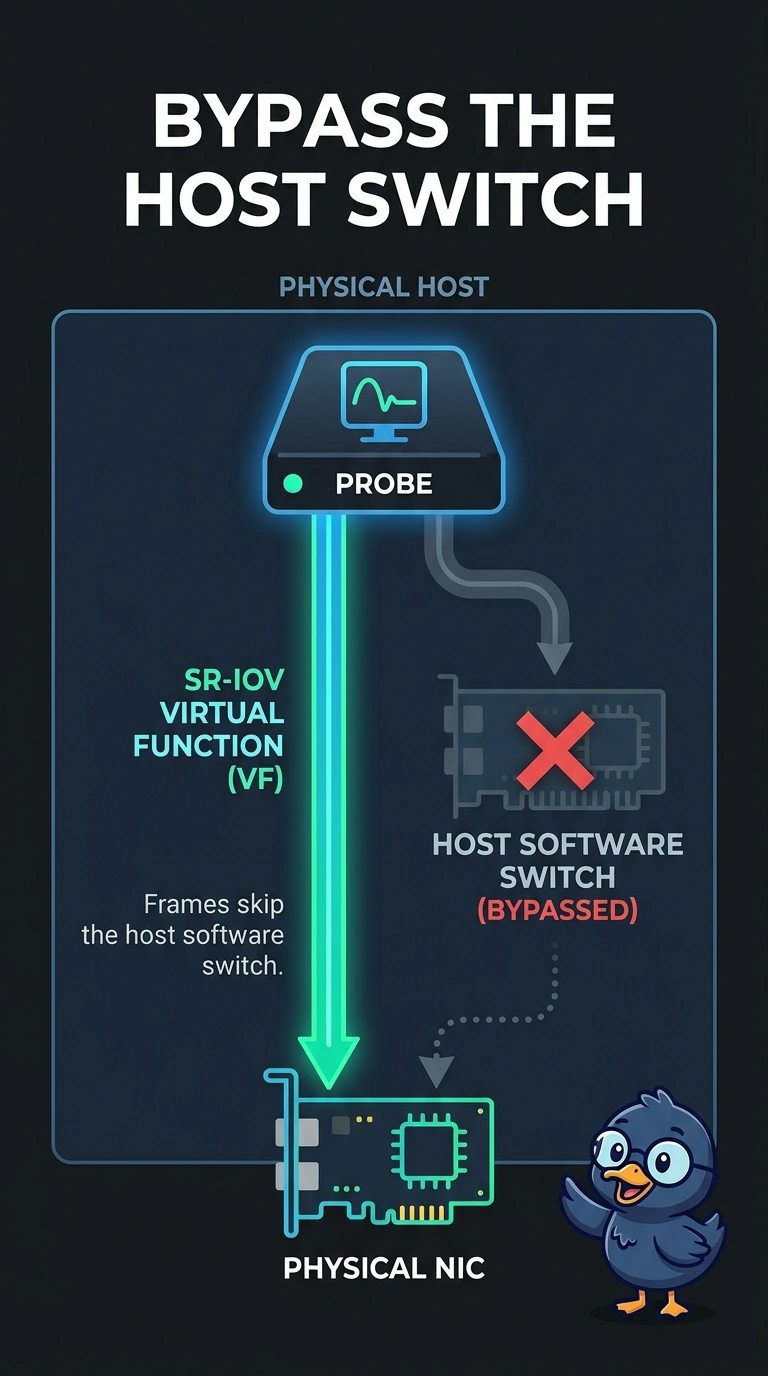
A private lane into the probe beats waiting behind a crowded toll booth. You give the probe an SR-IOV virtual function so frames skip the software switch that is dropping them. DPDK on another forwarder, VPP as a service node, and a second low-rate guest leave the probe behind that switch.
Full Explanation
Direct VF assignment bypasses the software switch for traffic delivered to that VF. DPDK and VPP move a forwarder into user space, which helps when that function is the packet engine. This probe is not the fabric forwarder. Frames die in the software switch before the guest sees them. A second low-rate guest does not need that treatment. Give the probe an SR-IOV virtual function so frames skip the host software switch is the design that meets this requirement. Move a separate user-space forwarder to DPDK and leave the probe behind the switch is the wrong fit because DPDK on a separate forwarder moves that forwarder to user space and still leaves this probe behind the dropping switch. Insert VPP as a service node and leave the probe on the host kernel path is the wrong fit because VPP as a service node is a user-space forwarder and does not hand the probe a path around the software switch. Add a second low-rate management guest and keep the probe on the software switch is the wrong fit because a second low-rate guest does not need a fast path and does not stop the switch from dropping the probe frames. Exam caveat: Use SR-IOV, DPDK, or VPP for a real packets-per-second problem. A low-rate guest does not need a virtual function or a user-space forwarder. Operational check: Verify that the capture feed reaches the VF and measure drops again.