
After a peering cutover, one shared edge router is congested. Operations must learn which tenant conversations filled that router, not the delay of a core path. Which record should the router export?
Select an answer to reveal the explanation.
Short Explanation
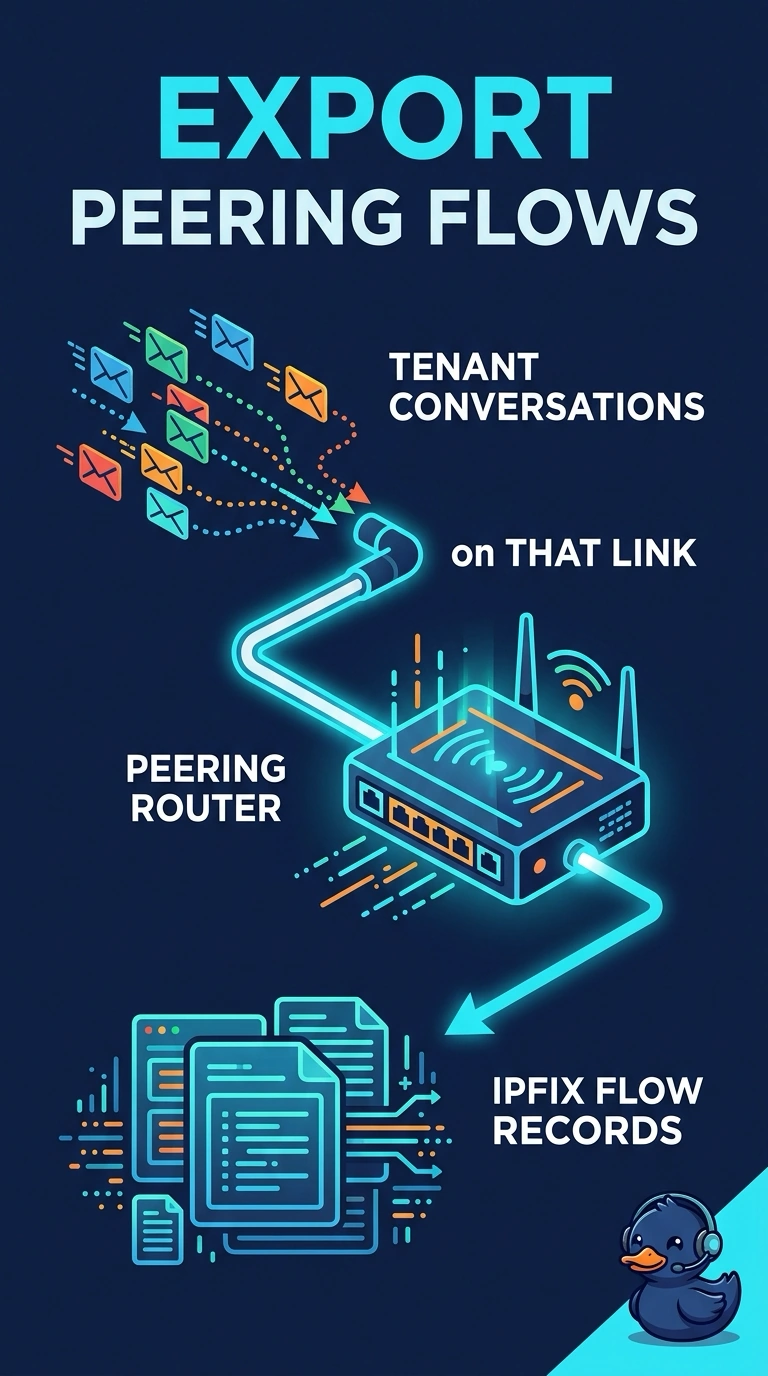
A turnstile log tells you who came through, while a stopwatch only times the hall. You need IPFIX from the peering router so the tenant conversations on that link are listed. Path-delay probes, syslog, and a cloud agent in one guest do not build that list.
Full Explanation
Segment-routing performance measurement probes path delay. Syslog is a log of events. A cloud agent reports from one guest. None of those name every tenant conversation on a shared peering router. IPFIX exports flow records from the router that forwarded them. On this congested peering edge, the router should export IPFIX so the conversations can be named. IPFIX flow records from the peering router that list the conversations on that link is the design that meets this requirement. Segment-routing performance probes that measure only delay along a core path is the wrong fit because Segment-routing performance measurement probes path delay and does not name the tenant conversations on the router. Syslog lines from the router as a stand-in for every tenant conversation is the wrong fit because Syslog records events the router logs and does not export the conversation list that filled the link. A cloud agent inside one guest as a view of every tenant on the router is the wrong fit because An agent in one guest sees that guest and cannot list every tenant conversation on the shared router. Exam caveat: IPFIX shows the flows the router exported. It is not a path-delay probe, and a sample rate can hide short conversations if the export is sampled. Rank the recorded flows by byte count for the affected interface and time window. Apply sampling context and map addresses or exported tenant identifiers to the actual tenant inventory.