
At a hosted studio cloud, every guest on one hypervisor misses its forwarding deadline. Guests on the other hypervisors are fine, disk reads succeed, and the API still lists that hypervisor as up. The affected host has sustained CPU saturation and elevated guest CPU scheduling wait; storage latency, NIC queues and packet-path counters are normal. Which layer is at fault?
Select an answer to reveal the explanation.
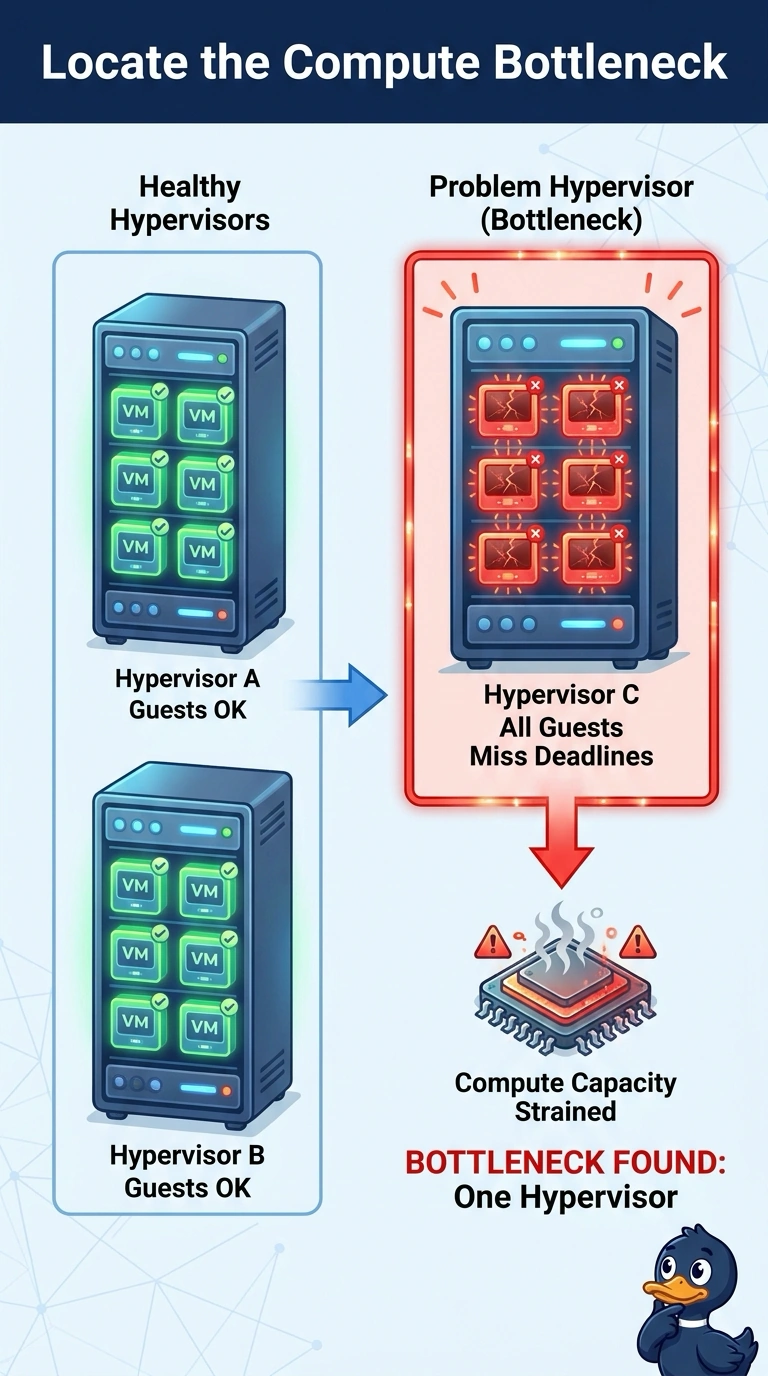
Short Explanation
You can localize the fault to the hypervisor when every guest there misses its forwarding deadline but guests on other hypervisors do not. Since disk reads succeed and the API still lists the hypervisor as up, the issue is compute capacity on that hypervisor.
Full Explanation
A compute-capacity fault follows the hypervisor. Here every guest on one hypervisor misses its forwarding deadline, guests on other hypervisors are fine, disk reads succeed, and the API still lists the hypervisor as up. That pattern points to compute capacity on the affected host: it has not disappeared, but it is not keeping up. A storage fault can affect selected guests or paths, but the normal storage latency and CPU-wait evidence here point to compute contention. A successful host-list call alone does not prove all API operations healthy; the measured CPU contention identifies this scenario’s layer. A single tenant guest is also a poor fit: other guests on that hypervisor would remain within their deadlines, whereas every guest there is affected. The claim that the hypervisor still has plenty of spare capacity does not match this host-wide symptom. Exam caveat: a hypervisor listed as up by the API can still have a compute fault; being powered off is only one kind of compute failure. Practical check: compare guest ready time or steal time on the affected hypervisor with the same counters on a healthy hypervisor before migrating or resizing.