
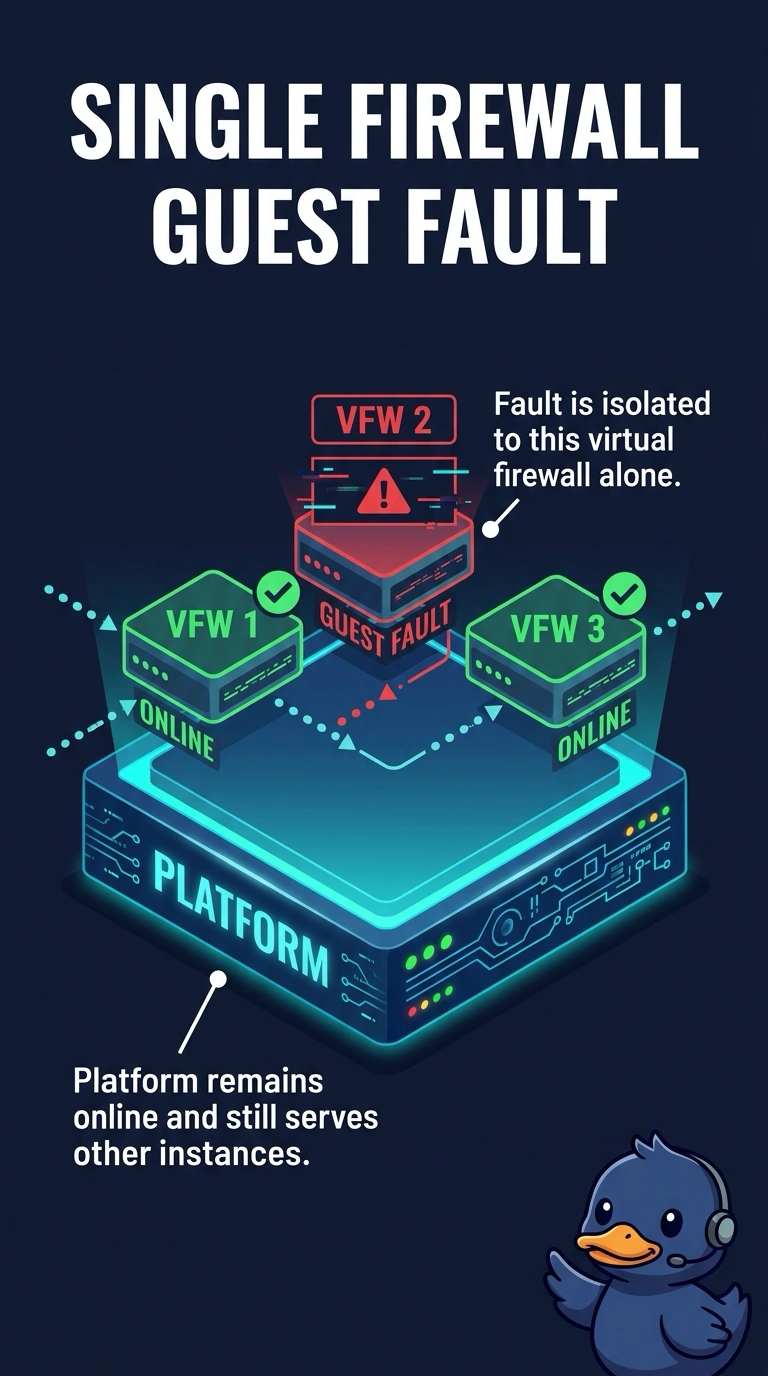
One tenant virtual firewall is stopped. The VIM API still creates other instances, the compute host is up, and storage volumes still attach. Which fault matches that evidence?
Select an answer to reveal the explanation.
Short Explanation
One dark apartment does not mean the building has lost power for you. You treat the stopped virtual firewall as a guest fault while the cloud around it still works. A VIM API failure, a compute host failure, and a storage failure contradict the healthy platform evidence.
Full Explanation
A guest fault means that tenant's workload is down while the platform around it still works. A VIM API fault shows up when the controller calls fail. A compute fault shows up on the host. A storage fault shows up when volumes do not attach. Here the API still creates other instances, the host is up, and volumes attach, so broad platform failure is not shown. The stopped virtual firewall is the guest, and a guest failure is not a VIM failure. A guest fault on that virtual firewall alone, while the platform still serves other instances is the design that meets this requirement. A VIM API fault declared from one stopped guest while the API still creates other instances is the wrong fit because successful creates show the control plane still works. A compute fault declared from one stopped guest while the host and other guests stay up is the wrong fit because an up host with running guests does not support a compute layer fault. A storage fault declared from one stopped guest while volumes still attach for others is the wrong fit because attach still works for others. Exam caveat: A stopped guest is not a VIM failure. Start with the affected instance’s status, fault record, console, and its own attached volume. Other healthy instances and successful API calls rule out a broad outage but do not establish this instance’s cause.