
A supported Cisco Nexus switch drops packets during short egress-queue bursts between counter polls. It supports hardware microburst detection with threshold-triggered event records, but that feature is disabled and no queue events are logged. Which method can capture the bursts the polls miss?
Select an answer to reveal the explanation.
Short Explanation
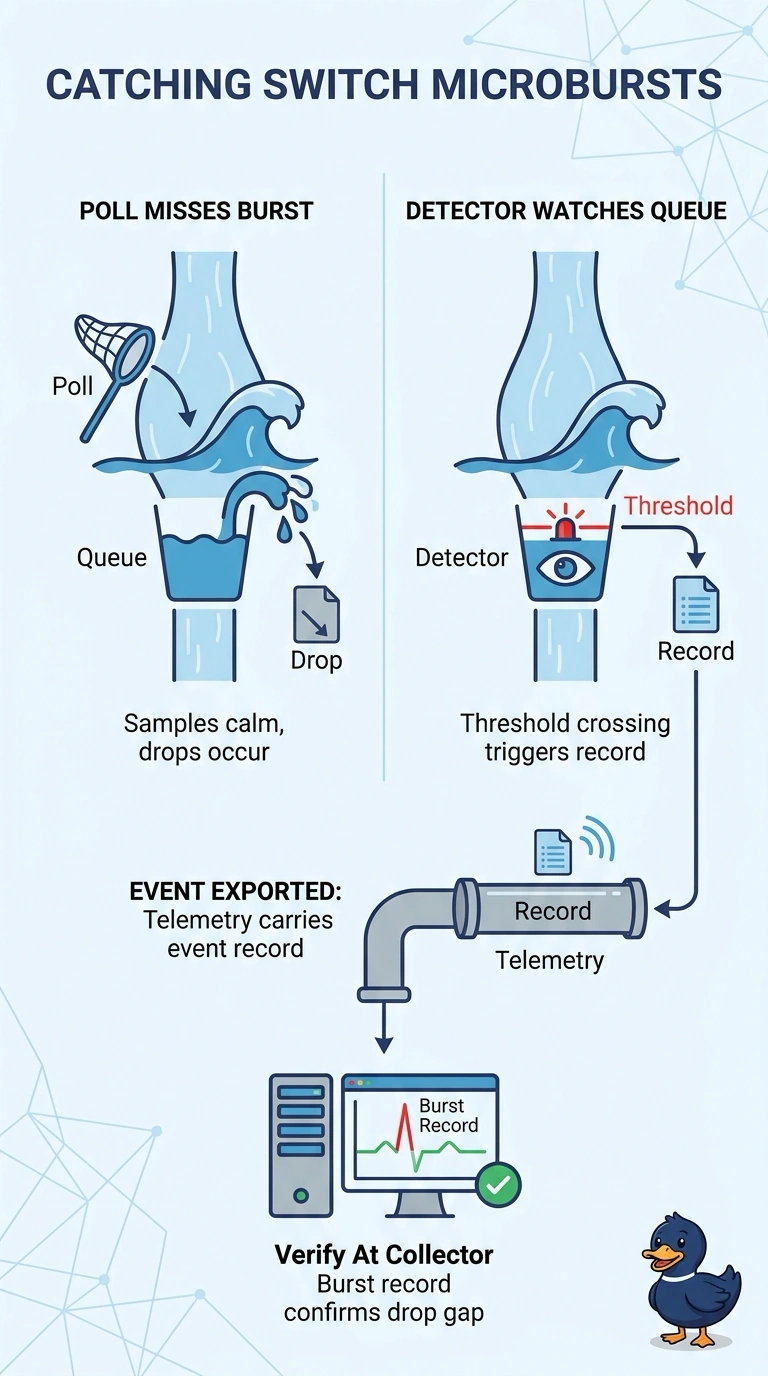
You need a camera that catches the wave, not another widely spaced snapshot. Your switch’s hardware microburst detector records queue events that ordinary polling can miss, while a slower counter poll, unsupported syslog message, or flow-focused IPFIX record won’t capture the needed queue event.
Full Explanation
Hardware microburst detection records supported threshold-crossing queue events, and supported telemetry can export those records. A generic sampled streaming subscription does not guarantee that it will observe a burst between samples. Polling returns the counter only when asked, so a short egress-queue spike that rises and falls between polls can stay invisible even when both samples look calm. A slower poll of the same queue-depth counter widens the blind gap and is even less likely to catch the spike. A syslog message could report a text event only if the platform emits one; this switch does not send queue-event syslog messages, so there is nothing of that kind to collect. An IPFIX record describes who communicated with whom and provides flow details, but it does not contain the queue-depth threshold event needed to identify this burst. Enabling the supported hardware detector captures the threshold crossing at the source, and exporting its event records through supported telemetry makes them available for analysis. As an exam caveat, telemetry export alone does not create queue events when the detector is disabled. Verify platform support, detector thresholds, and event export; then reproduce a burst and confirm that a detector record arrives at the collector.