
A rural clinic network must stay reachable if its primary upstream route fails, and adding name servers alone will not fix a lost route. Which design provides routing redundancy?
Select an answer to reveal the explanation.
Short Explanation
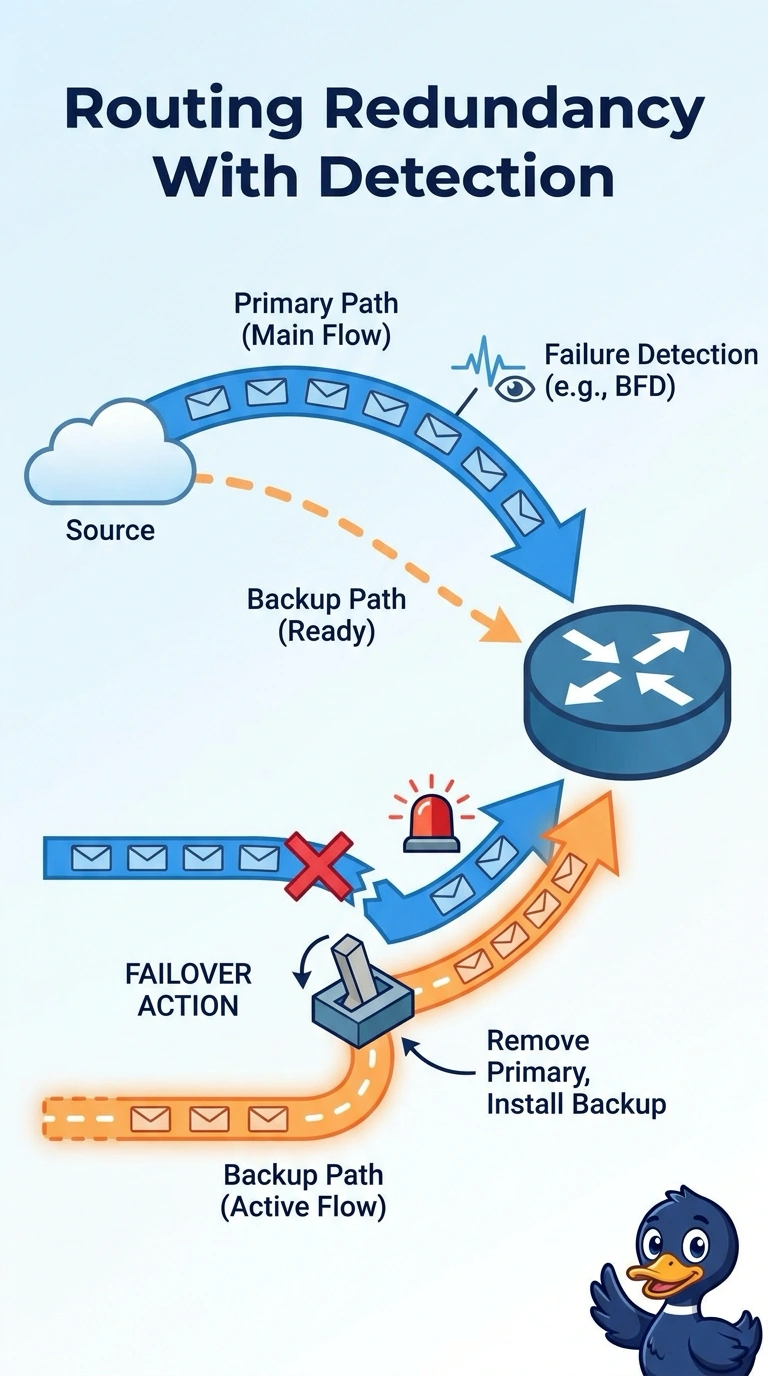
You’re right that another name server won’t restore a lost route. You stay reachable by giving your router an independent alternate path and failure detection that selects it when the primary fails. That backup path protects you when the primary route drops.
Full Explanation
Configuring an independent alternate path with routing or next-hop failure detection is correct because routing redundancy requires both a usable backup route and a mechanism that stops forwarding through a failed primary. A redundant static route with a different next hop can support a simple edge design; the backup becomes usable when the primary is removed from forwarding. Use supported next-hop tracking or BFD when link state alone cannot detect the failure. Pointing clients to a second DNS resolver does not create upstream reachability: DNS translates names to addresses, but queries still have no path out of the site if the route is lost. Adding a second DHCP scope changes local address assignment, not upstream path selection or recovery from a WAN next-hop failure. Keeping a single static default toward one provider leaves a single point of failure; if that next hop or peering session drops, there is no alternate route to install. Exam caveat: a backup route is useful only if its next hop is reachable and failure detection can identify the relevant outage; a local link may remain up while upstream connectivity fails. Practical check: withdraw the primary route and verify that traffic shifts to the backup path.