
A warehouse firewall must dual-home to two provider edges so one edge can fail, and the two links must behave as one bundle without a forwarding loop. Which design matches that requirement?
Select an answer to reveal the explanation.
Short Explanation
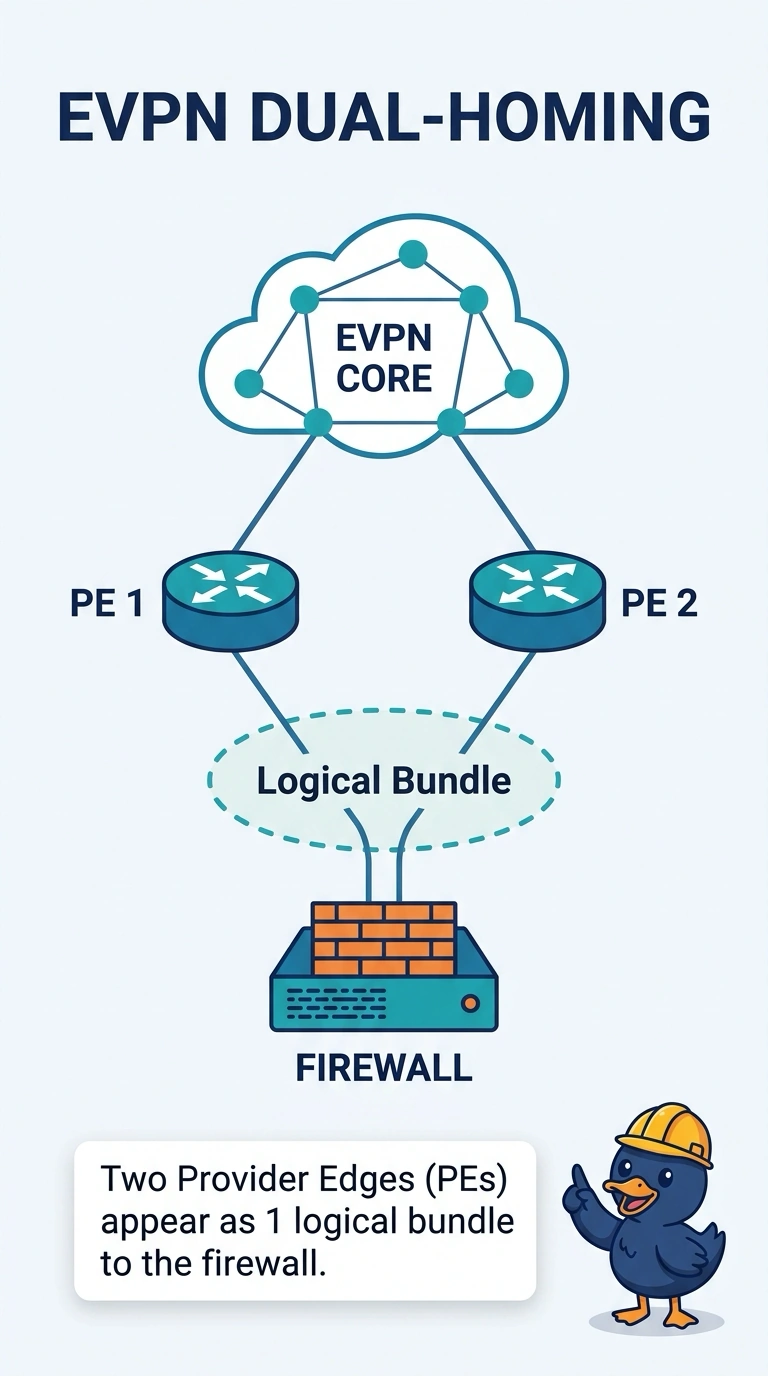
You need EVPN multihoming to present both provider edges to your firewall as one logical bundle, so forwarding can continue if one edge fails without creating a loop. A port channel on only one edge lacks the second edge, two independent forwarding links lack a coordinating bundle, and spanning tree blocks one link instead of providing an active bundle across both edges.
Full Explanation
EVPN multihoming that presents the two provider edges as one logical bundle to your warehouse firewall meets the requirement: if one edge fails, your firewall can keep forwarding through the other, and the multihomed bundle coordinates both links to prevent a forwarding loop while both edges are up. A port channel that terminates both member links on only one provider edge does not provide a second edge, so failure of that edge removes the firewall’s connection. Two independent links that both forward without a multihomed bundle are not coordinated as one bundle and can create a forwarding loop or split-brain behavior when both edges are active. Spanning tree that blocks one link can retain redundancy by unblocking it after a failure, but it does not make the two provider-edge links one active customer-facing LAG. Exam caveat: EVPN multihoming connects one device to two provider edges; it is not the same as adding a second provider reached through a single edge. Practical check: confirm that your firewall sees one bundle connected to both provider edges, then shut one edge and verify that the bundle keeps forwarding through the other without a loop.