
A hospital virtual firewall has two uplinks, and both of them terminate on the same provider edge router, so a reboot of that router isolates the firewall. Which change removes that shared failure?
Select an answer to reveal the explanation.
Short Explanation
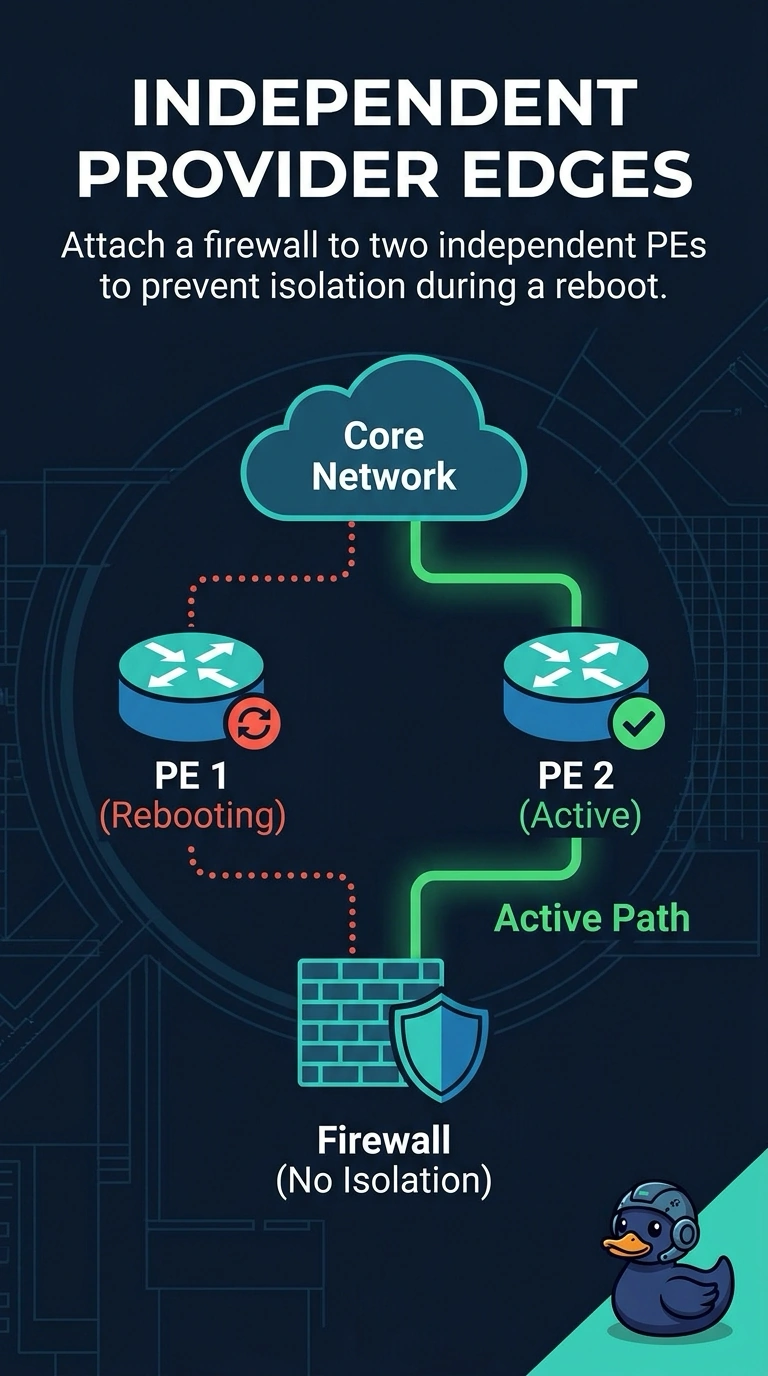
Two driveways that cross the same bridge still leave you stranded when that bridge closes. You need the firewall on two provider edges that fail independently, not two cords into one router. A third link on that router, equal-cost paths across it, and a second VLAN on the same uplink each keep the single reboot as the outage.
Full Explanation
Multihoming connects the site or device through multiple attachments. To survive the failure in this scenario, put the attachments in separate failure domains and verify that traffic can use either path. Both hospital uplinks end on one provider edge, which means they are one failure, not two. A third link, equal-cost forwarding, or another VLAN on that same router still shares the reboot that isolates the firewall. The fix is a second edge that does not depend on the first. Attach the firewall to two independent provider edges so one edge reboot cannot isolate it is the design that meets this requirement. Add a third uplink that also terminates on the same provider edge router is the wrong fit because a third link on the same edge still dies when that router reboots, so the firewall keeps one shared failure point. Turn on equal-cost forwarding across the two links that still share that one router is the wrong fit because equal-cost paths across two links do not help when both links share the router whose reboot isolates the firewall. Add a second VLAN on the same physical uplink toward that same provider edge is the wrong fit because another VLAN on the same uplink is still one physical path into the same edge, so the reboot still isolates the site. Exam caveat: Two links are multi-homing only when they reach independent devices or providers, and two circuits that share one upstream edge still count as one failure. Operational check: Confirm each firewall uplink terminates on a different provider edge and that rebooting either edge alone leaves the other uplink forwarding. For a stateful firewall, verify session continuity separately from reachability.