
A harbor crane cloud fabric runs IS-IS toward two physical routers at equal cost, yet forwarding uses only one next hop. Which change keeps both next hops alive?
Select an answer to reveal the explanation.
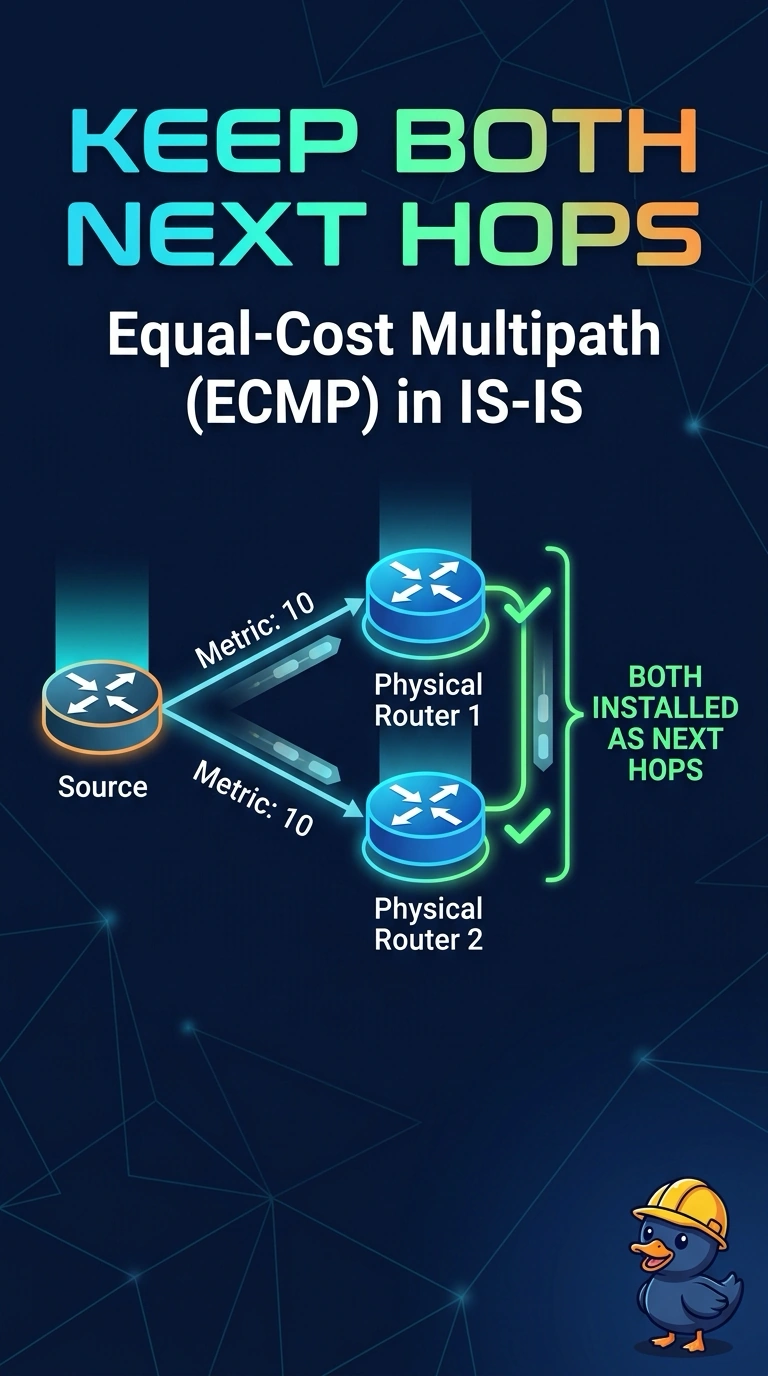
Short Explanation
Equal-cost multipath is like two open checkout lanes when the lines are the same length. You keep both IS-IS next hops installed so the harbor fabric can use each physical router. A single static default, BGP multipath, and OSPF equal-cost multipath each follow a path this fabric is not using.
Full Explanation
Equal-cost multipath keeps every equal next hop in the forwarding table. This harbor fabric already has two IS-IS costs that match, and it still uses only one router. Verify that the IS-IS route computation produces equal-cost next hops for the same prefix and that the configured maximum-paths, RIB, and forwarding hardware permit both. A single static default is one route, not multipath. BGP multipath applies to BGP next hops this path does not have. OSPF multipath applies only where OSPF is the protocol, and this fabric is not running OSPF. Equal-cost multipath in IS-IS so the fabric installs both physical routers as next hops is the design that meets this requirement. One static default toward a single physical router, leaving the second router unused is the wrong fit because one static default pins forwarding to a single router and does not install both equal-cost next hops. BGP multipath toward peers that do not carry this harbor fabric path at all is the wrong fit because this harbor path is IS-IS, so BGP multipath has no equal BGP next hops on this fabric to install. OSPF equal-cost multipath on a fabric that is not running OSPF to those routers is the wrong fit because the fabric is not running OSPF to those routers, so OSPF multipath has no equal costs to use. Exam caveat: Equal-cost multipath in IS-IS keeps both next hops only while those costs stay equal, and a later cost change can leave one physical router idle. Operational check: Confirm the harbor fabric lists two equal-cost IS-IS next hops toward the two physical routers and that traffic can leave by either physical router.