
A Cisco IOS XR cloud edge uses ordinary equal-cost BGP multipath with a path limit greater than one and no unequal-cost or IGP-metric-ignore feature. All other multipath eligibility checks pass for two paths to one prefix, but one BGP next hop has a higher IGP metric. Only one path is installed. Why is the second path left out?
Select an answer to reveal the explanation.
Short Explanation
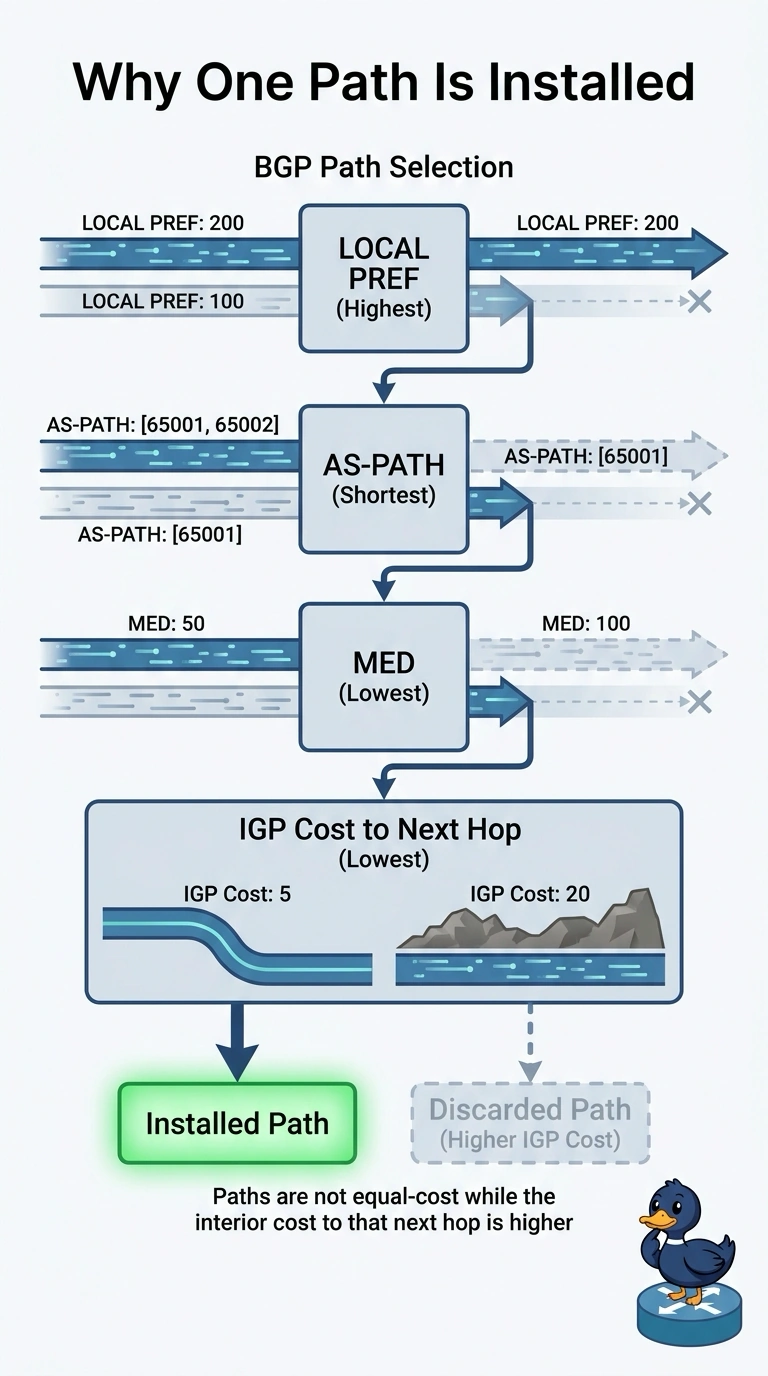
Two roads to the same town are not a tie if one of them is uphill the whole way. Your BGP attributes match, and you see the interior cost to one next hop is higher. Equal-cost multipath leaves that path out of the forwarding table because the costs are not equal.
Full Explanation
Equal-cost multipath adds a BGP path only when it ties the best path on the attributes that matter and the interior cost to the BGP next hop is the same. Local preference, AS-path length, and MED already match here. The higher interior cost means the second path is not equal-cost, so it stays out of the forwarding table even though it is a valid BGP candidate. Raising a path limit would matter only after the paths qualify as equal; a limit of one is not the reason when the stem says the interior costs do not match. Calling both paths equal-cost ignores the higher interior cost the scenario states, and a path that should already be forwarding would already be installed. A resolver answers names and does not install BGP next hops. Exam caveat: a platform can be configured for unequal-cost multipath as a separate feature; ordinary equal-cost multipath does not install the higher interior-cost next hop. Operational check: compare the interior metric to each BGP next hop and confirm the higher one is absent from the forwarding entry for that prefix.