
A regional bank uses a provider-hosted virtual firewall with two instances for continuity, but both instances went down when one compute host failed. The two instances already have supported automatic firewall failover, the required state handling, and independent usable network paths. Which scheduler placement policy removes their shared compute-host failure?
Select an answer to reveal the explanation.
Short Explanation
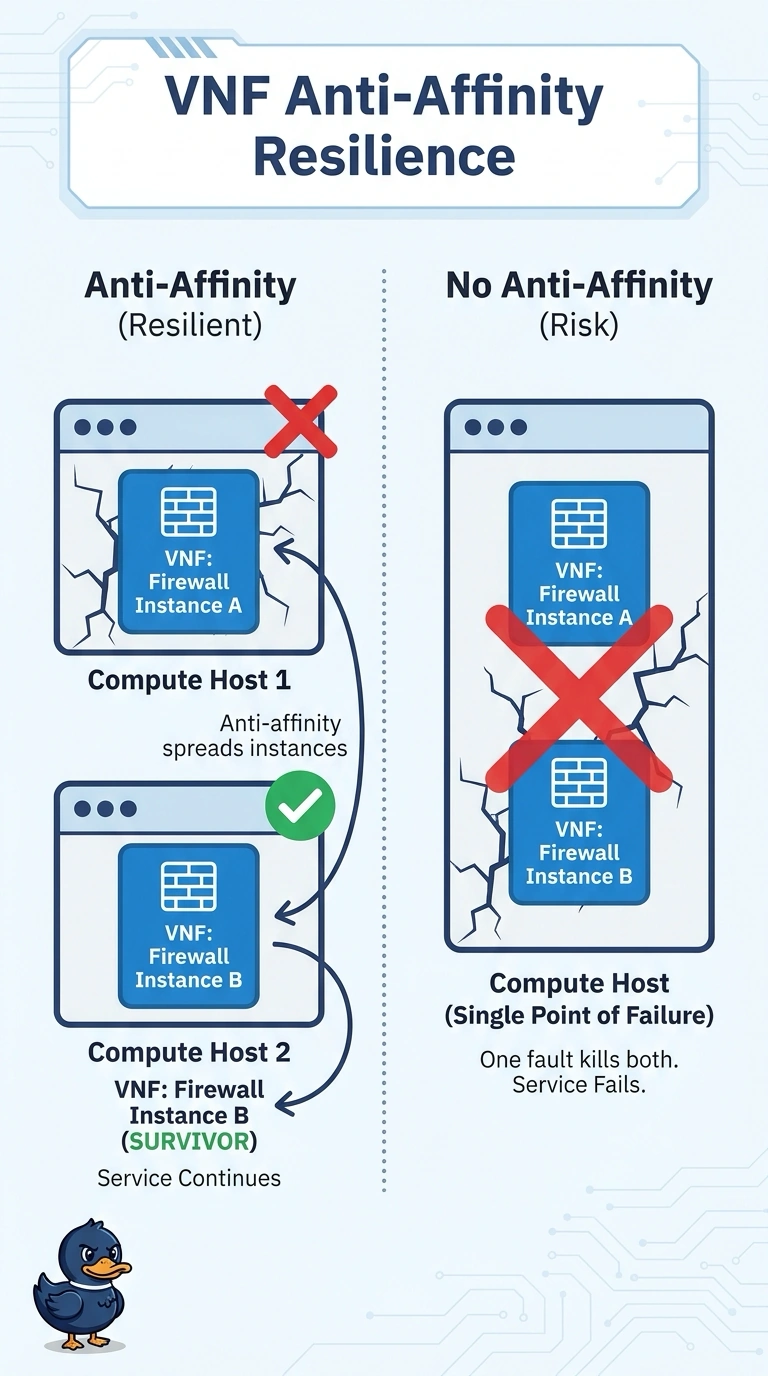
Think of storing your spare key in a different building, not the same drawer, so you still have access. Anti-affinity preserves a surviving instance after one host fails. The configured firewall failover and traffic paths provide service recovery.
Full Explanation
Enforce host anti-affinity so the redundant firewall instances run on different compute hosts to provide host-level resilience for the virtualized service. Anti-affinity tells the cloud scheduler to keep the redundant VNFs apart, so a single compute host failure, reboot, or maintenance event affects only one instance while the peer continues forwarding. Anti-affinity preserves a surviving instance after one host fails. The configured firewall failover and traffic paths provide service recovery. Placing both firewall instances on the same compute host to keep traffic local is the wrong fit because that host becomes a single point of failure and any fault removes the whole service at once. Running a single larger firewall instance so only one instance needs monitoring is the wrong fit because no standby exists, so any software or host fault causes full outage. Keeping the standby firewall powered off until staff manually start it after a failure is the wrong fit because cold standby needs manual recovery and does not protect traffic during the outage. Exam caveat: use same-host packing only when locality outweighs availability. Operational check: verify scheduler placement shows instances on separate hosts, then simulate one host failure and confirm traffic continues.