
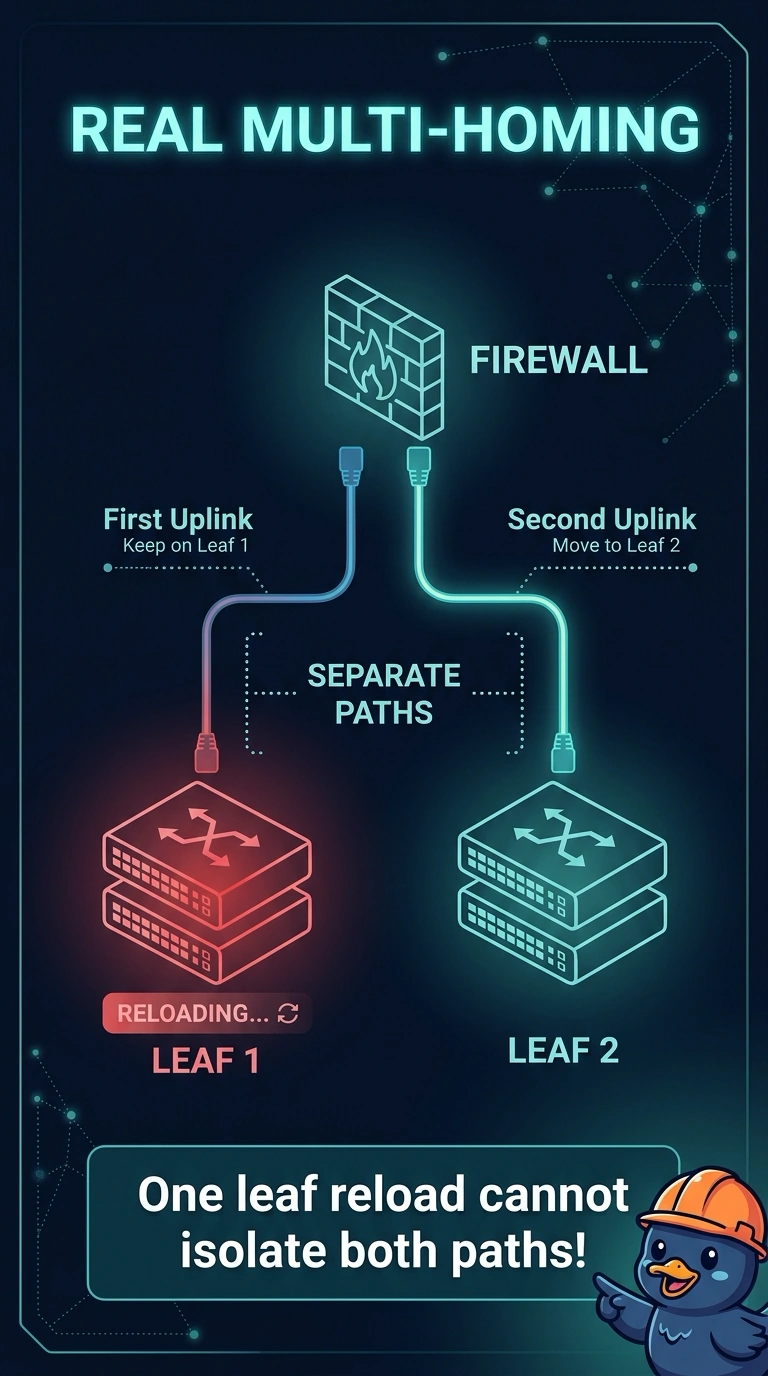
Both uplinks of a ferry-terminal virtual firewall are pinned to the same leaf, so a reload of that leaf drops every session. A second carrier name would still land on that leaf. Which change is real multi-homing?
Select an answer to reveal the explanation.
Short Explanation
Two doors on different buildings let you leave when one building closes, and two doors on the same wall do not. You pin the firewall's second uplink to a different leaf so one reload leaves a path. Another link on the same leaf, extra VLAN tags, and a second provider that still uses that leaf share one failure.
Full Explanation
Multihoming connects the site or device through multiple attachments. To survive the failure in this scenario, put the attachments in separate failure domains and verify that traffic can use either path. Two or three links on the same leaf share that leaf. Extra VLAN tags on one virtual NIC still face the same leaf. A second provider circuit that lands on the same leaf shares the same failure. The second uplink has to terminate on a different leaf. Move one uplink to a second leaf so one leaf reload cannot isolate both firewall paths is the design that meets this requirement. Add a third link that is also pinned to the same leaf as the two existing uplinks is the wrong fit because another link on the same leaf still dies when that one device reloads, so the firewall is not independently attached. Tag two VLANs on one virtual NIC that still terminates only on that original leaf is the wrong fit because extra VLAN tags on one NIC toward the same leaf do not create a second device in the forwarding path. Buy a second provider circuit that the design still delivers on that same single leaf is the wrong fit because a second provider name is not independence when both circuits still share the one leaf that can isolate the firewall. Exam caveat: Two providers are real multi-homing only when their attachments do not share one upstream device that can fail both paths at once. A shared leaf is that device. Operational check: Reload the original leaf in a maintenance window and confirm the firewall stays reachable on the second leaf. For a stateful firewall, verify session continuity separately from reachability. Then restore it.