
A power-utility cloud fabric learns two equal-cost OSPF paths toward campus and forwards on only one of them. BGP is not running on those adjacencies. Which change gives equal-cost multipath?
Select an answer to reveal the explanation.
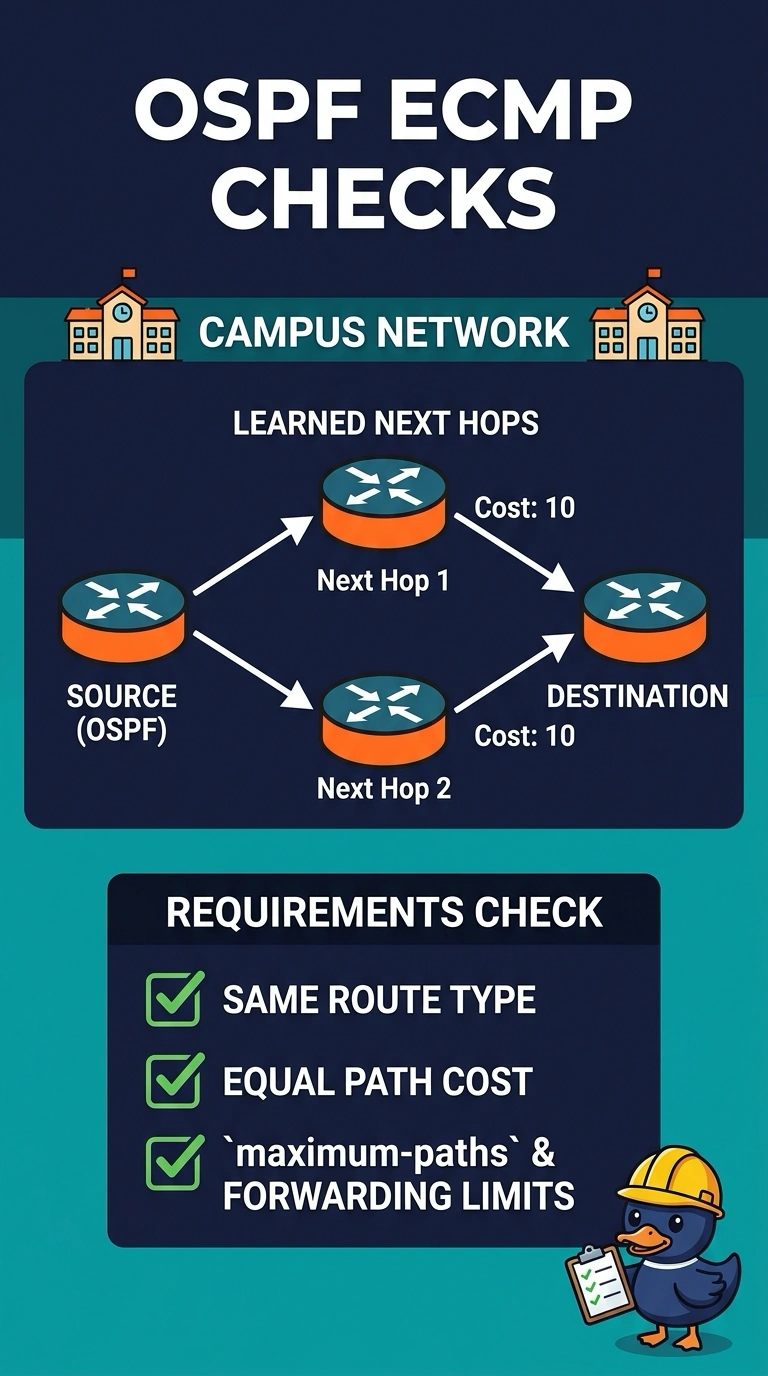
Short Explanation
You can picture two equal-width gates letting the crowd split, while one handwritten detour sign sends everyone the same way. Check that both OSPF routes qualify for ECMP and that the fabric’s limits allow both next hops.
Full Explanation
Equal-cost multipath (ECMP) keeps more than one next hop active only when candidate paths are truly equal and the router is allowed to install them together. This fabric sees two candidate OSPF paths but uses only one, so verify that both OSPF routes have the same route type and total path cost to the destination, and that OSPF maximum-paths and forwarding limits permit both. Route type matters because OSPF prefers intra-area, inter-area, and external types before comparing cost; total path cost must also tie for ECMP. A single static default route toward one campus router uses one next hop rather than sharing traffic across the OSPF paths, collapsing redundancy instead of creating multipath. Two static routes at different preference make one campus router primary and the other a backup, not equal-cost paths used together, because different preferences prevent simultaneous installation. BGP multipath applies to BGP-learned routes, but these adjacencies have no BGP session to campus and the paths are learned through OSPF, so there are no BGP next hops to load-share. Exam caveat: BGP multipath is appropriate when equal-cost next hops are learned in BGP. Practical check: Confirm that the fabric lists two OSPF next hops for the campus prefix.