
A virtual CGNAT control process already has a standby on another compute in the same cloud, yet packets died when the only top-of-rack in the data path failed. Which addition covers that failure?
Select an answer to reveal the explanation.
Short Explanation
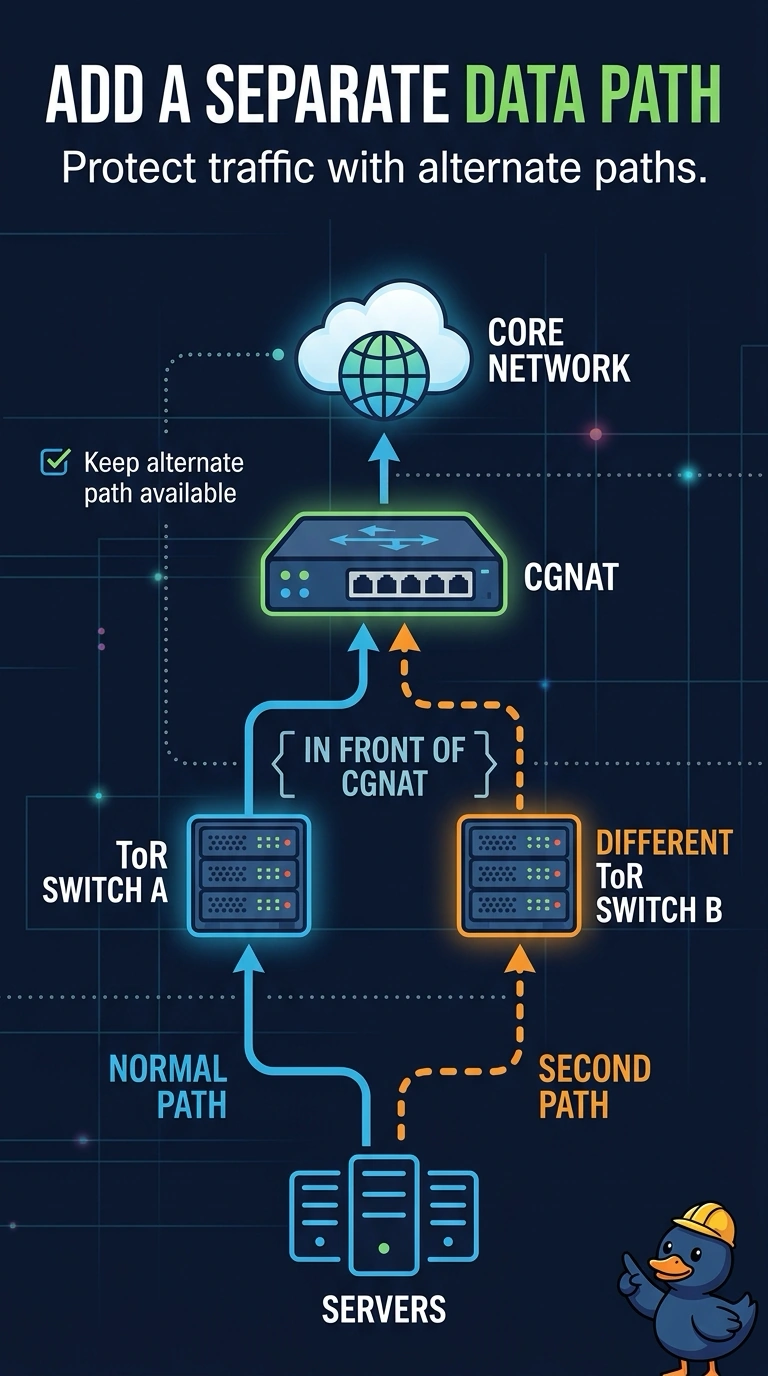
You keep packets moving by adding a second data path through a different top-of-rack switch, since the existing control-process standby was already running when traffic stopped. Another same-cloud control standby, a standby in an unrelated cloud, or a larger flavor on the same host behind the same switch would not give you that independent path.
Full Explanation
The failure was in the forwarding path, so resilience must include a path through a different top-of-rack switch. A second data path that leaves through a different top-of-rack switch in front of the CGNAT addresses the failure: packets can use a path that does not depend on the failed switch. Another control-process standby in the same cloud beside the existing standby repeats control-process protection but does not give packets another top-of-rack. A control-process standby in a second unrelated cloud outside this VIM also protects a control process, not the failed switch in this forwarding path. A larger compute flavor for the active CGNAT on the same host behind the same top-of-rack still relies on that one switch, so it cannot cover its failure. Exam caveat: a control-process standby is useful when the control process fails while the forwarding path remains intact; it does not replace data-plane redundancy. As a practical check, verify that traffic reaches the CGNAT through the alternate path when the original top-of-rack is unavailable.