
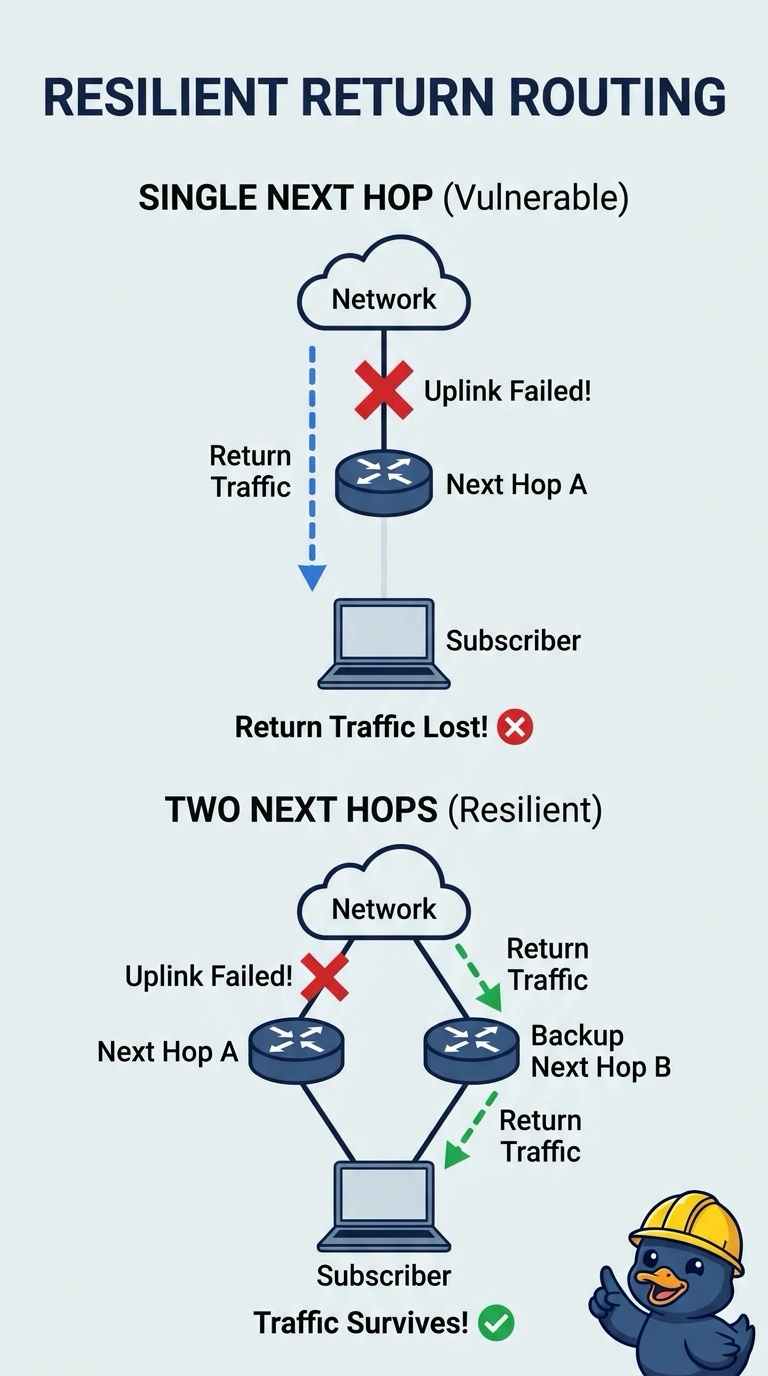
Clients resolve the service name, the load balancer answers, and its health checks pass. Return traffic from the balancer stops when one uplink fails, because that uplink is the only next hop. What resilience is missing?
Select an answer to reveal the explanation.
Short Explanation
The map is right and the lobby is open, but the road home has one bridge. You need a second routing next hop so return traffic survives one uplink. A second resolver, a second load-balancer node, and anycast DNS protect pieces that are already working.
Full Explanation
A second resolver or anycast DNS helps when the name does not resolve. A second load-balancer node helps when the balancer is dead. Here the name resolves, the balancer answers, and health checks pass. Return traffic has a single next hop, so one uplink loss black-holes the way back. The missing piece is a second routing next hop, not more DNS and not another balancer. A second routing next hop so return traffic survives the loss of one uplink is the design that meets this requirement. A second recursive resolver for a name lookup that is already succeeding is the wrong fit because Name lookup already succeeds, so another resolver does not give the return traffic a second next hop. A second load-balancer node for a balancer whose health checks already pass is the wrong fit because The balancer already answers and its health checks pass, so another node does not fix the single uplink route. Anycast DNS aimed at a failure that starts after the client reaches the balancer is the wrong fit because Anycast DNS covers name resolution, and this failure starts after the client has reached the balancer. Exam caveat: Match the resilience to the component that failed. A passing load-balancer health check does not prove the return route has a second next hop. Operational check: Shut one uplink and confirm return traffic uses the other next hop while the name still resolves and the balancer health check stays up for the pool.