
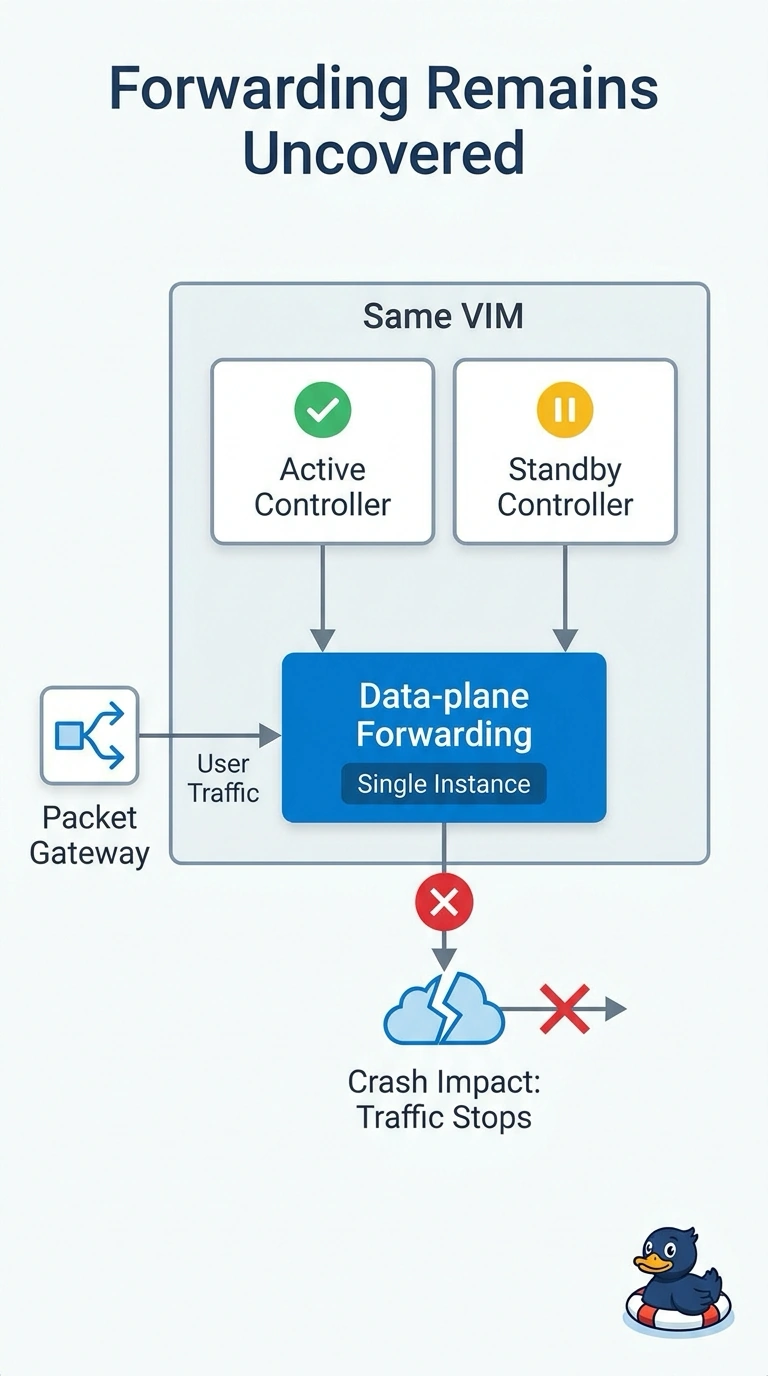
A mobile-core cloud already runs an active controller and a standby controller in the same VIM. User traffic still stops when the single packet-gateway forwarding process crashes. What does the controller pair leave uncovered?
Select an answer to reveal the explanation.
Short Explanation
A spare pilot in the tower does not give you a second airplane. You already have a standby controller in this cloud, and the crash that stops users is the one forwarding process. That pair covers the control function, not the data plane.
Full Explanation
Control-plane resilience inside one VIM means a standby controller or control process can take over API and scheduling work in that same cloud. The mobile core in this scenario already has that pair. The failure that black-holes user traffic is the single packet-gateway forwarding process, which is the data plane. A controller standby does not create a second forwarding instance, so the data plane is what the pair leaves uncovered. Controller elections are already covered by the standby the stem describes, so they are not the remaining gap. Name lookups that still resolve are a DNS path, and nothing in the crash points at DNS. A second orchestration login changes who may call the API; it does not forward subscriber packets when the only gateway process is dead. Exam caveat: do not treat a healthy controller pair as proof the service has a second forwarding path. Operational check: confirm a second forwarding instance exists on separate compute and that user traffic fails over to it when you stop the first process.