
A clinic buys two carrier circuits for a virtual router, but both enter through one building riser and both terminate on one upstream router. What attachment survives a failure of that shared router?
Select an answer to reveal the explanation.
Short Explanation
Two doors that open into the same hallway still trap you when that hallway closes. You need two providers that do not share the riser or the upstream router. A second VLAN, a second BGP session, and a second static default on that same router stay in the one hallway.
Full Explanation
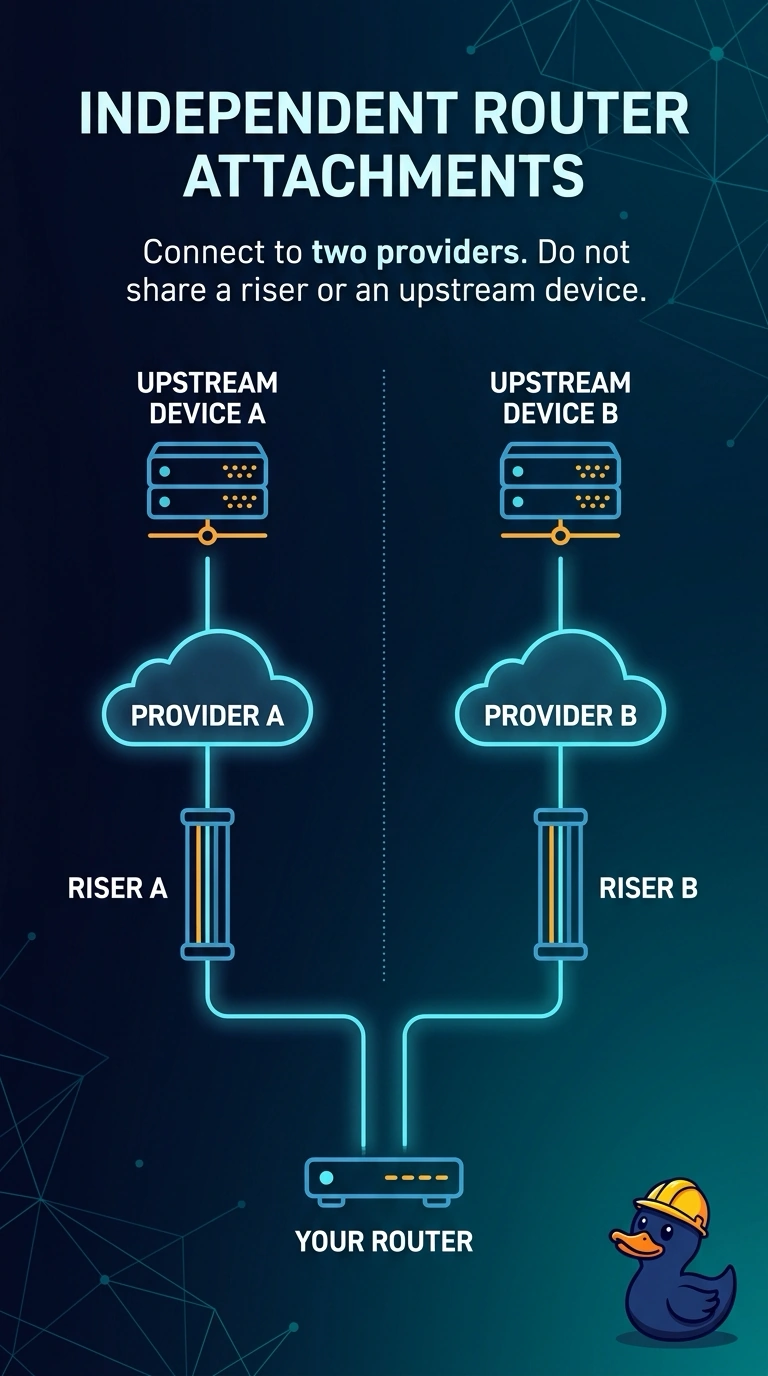
Multihoming connects the site or device through multiple attachments. To survive the failure in this scenario, put the attachments in separate failure domains and verify that traffic can use either path. Independence is the failure domain, not how many labels sit on one cable. Two circuits that share a riser and an upstream router are one failure. Attach the router to two providers that do not share a riser or an upstream device is the design that meets this requirement because each uses a separate entry and device. Add a second VLAN on the same riser and label it a diverse provider path is the wrong fit because that VLAN still fails when that shared riser or its one upstream router fails. Open a second BGP session to the same upstream router over the same cross-connect is the wrong fit because that session shares the one device failure. Point a second static default at that same upstream router for the clinic site is the wrong fit because that default still leaves the site with one device to lose. Exam caveat: Two provider names are not independence if the physical entry and the upstream device are still shared. Operational check: Trace each attachment to its building entry and its upstream device, then shut one device and confirm the other path stays up. For a stateful firewall, verify session continuity separately from reachability.