
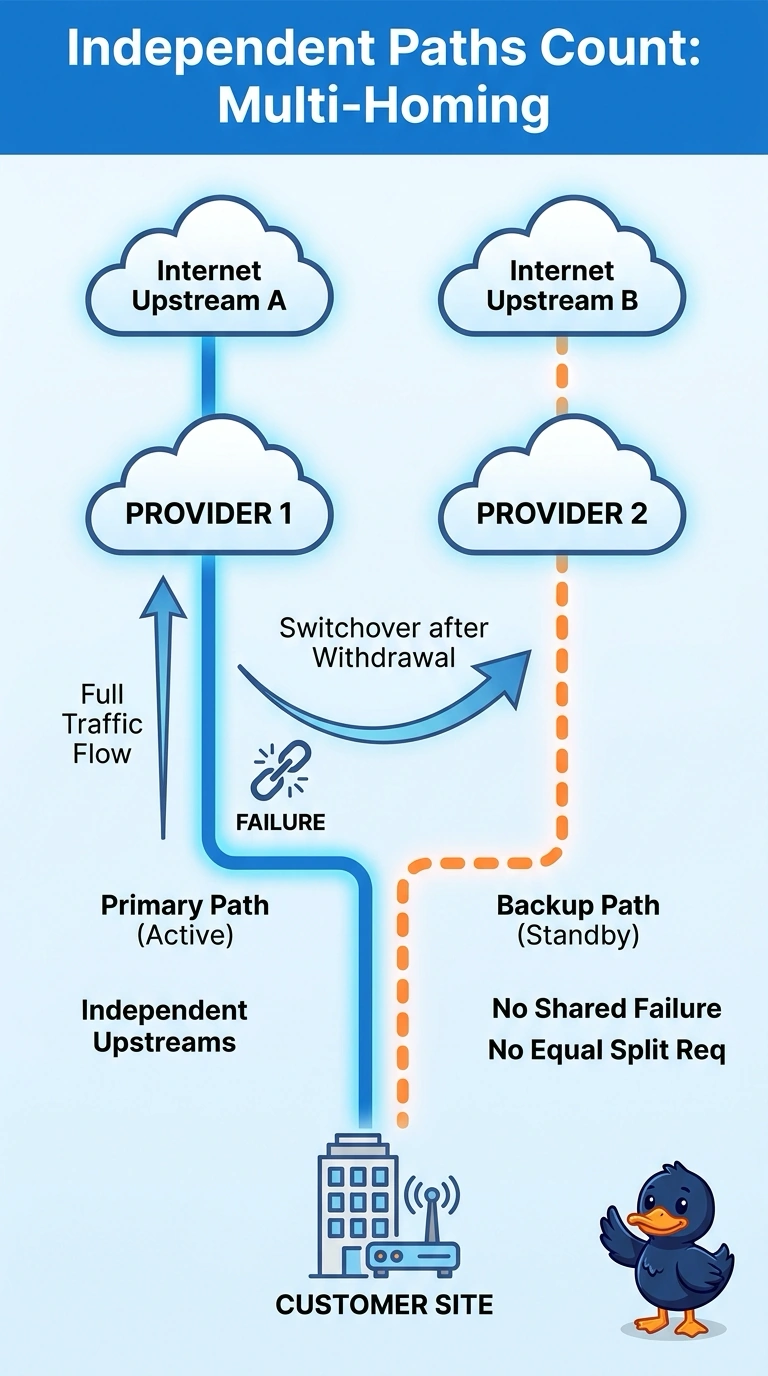
An airport firewall sends all traffic to one provider and uses a second provider only after the first withdraws its routes. The providers do not share an upstream failure. A reviewer says this is not multi-homing because traffic is not split. What is the right conclusion?
Select an answer to reveal the explanation.
Short Explanation
A spare generator that sits quiet until the first one dies is still a second source of power. You have two providers that do not share an upstream failure, and one of them waits until the other withdraws. That is multi-homing; nobody required the traffic to be split in half.
Full Explanation
Multi-homing connects the site through multiple attachments; independent failure domains improve the resilience those attachments provide. An active path and a standby path meet that definition when the providers do not share an upstream failure. Equal splitting is a traffic-engineering choice, not a requirement for the attachment to count. Waiting until both providers carry traffic at once confuses load sharing with survival. Two links to one provider edge share that edge’s failure domain and do not provide protection against its loss. A standby path is not automatically a shared failure: a shared failure would be one upstream event that removes both providers, which the stem says is not the case. Exam caveat: the standby still has to detect the withdrawal and take over; multi-homing that never fails over is only a drawing. Operational check: withdraw the primary provider's routes in a test and confirm the firewall forwards through the second provider without a second failure domain in that path. Test the withdrawal: if the second provider is independent and takes the traffic, the reviewer's demand for an equal split was never part of the definition.