
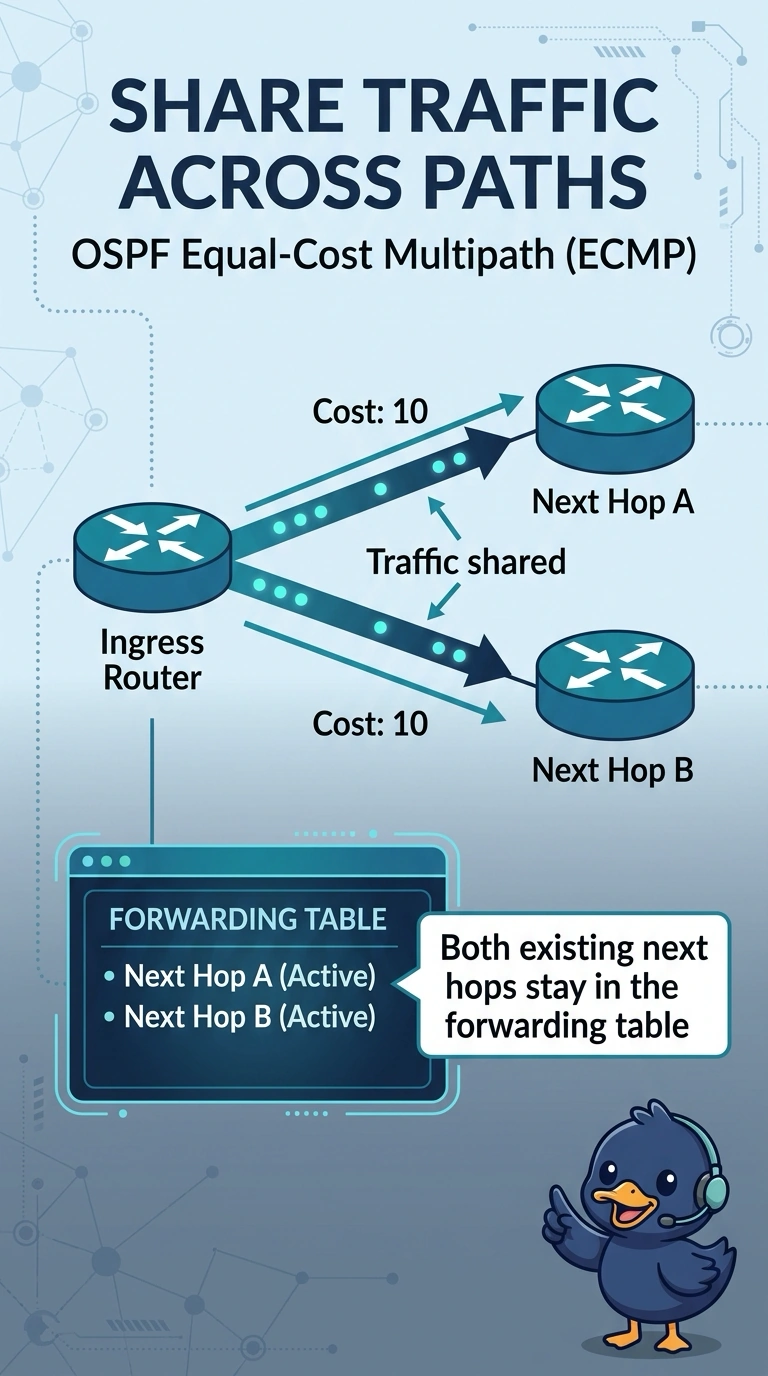
A cloud edge learns two equal-cost OSPF paths toward the physical network and still forwards on only one next hop. How should both paths carry traffic?
Select an answer to reveal the explanation.
Short Explanation
Two identical doors are unlocked and your building still shoves every visitor through one of them. Verify that both OSPF routes have the same route type and total path cost to the destination and that the OSPF maximum-paths and forwarding limits permit both. A static default, BGP multipath, and IS-IS multipath either pin a single exit or invoke a protocol that does not own these paths.
Full Explanation
Equal-cost multipath keeps more than one next hop active when the costs really are equal. This edge already learns two equal OSPF costs and installs only one. Verify that both OSPF routes have the same route type and total path cost to the destination and that the OSPF maximum-paths and forwarding limits permit both. OSPF equal-cost multipath so both existing next hops stay in the forwarding table is the design that meets this requirement. One static default route pointed at the first of the two OSPF neighbors is the wrong fit because a single static default selects one exit, and it does not keep both equal OSPF next hops forwarding. BGP multipath for this exit on a fabric that has no BGP session for it is the wrong fit because BGP multipath needs multiple BGP paths, and this exit is learned only as two equal-cost OSPF paths. IS-IS equal-cost multipath on a core that does not learn this exit in IS-IS is the wrong fit because IS-IS multipath would apply only to IS-IS routes, and the two equal costs here are OSPF routes. Operational check: Check the forwarding table on the cloud edge for both OSPF next hops toward the physical network and confirm traffic actually uses each of them.