
A studio edge has two equal-cost paths installed toward the cloud. One large transfer fills only one path, the other path stays nearly idle, and smaller flows use both paths. What explains the one-sided transfer?
Select an answer to reveal the explanation.
Short Explanation
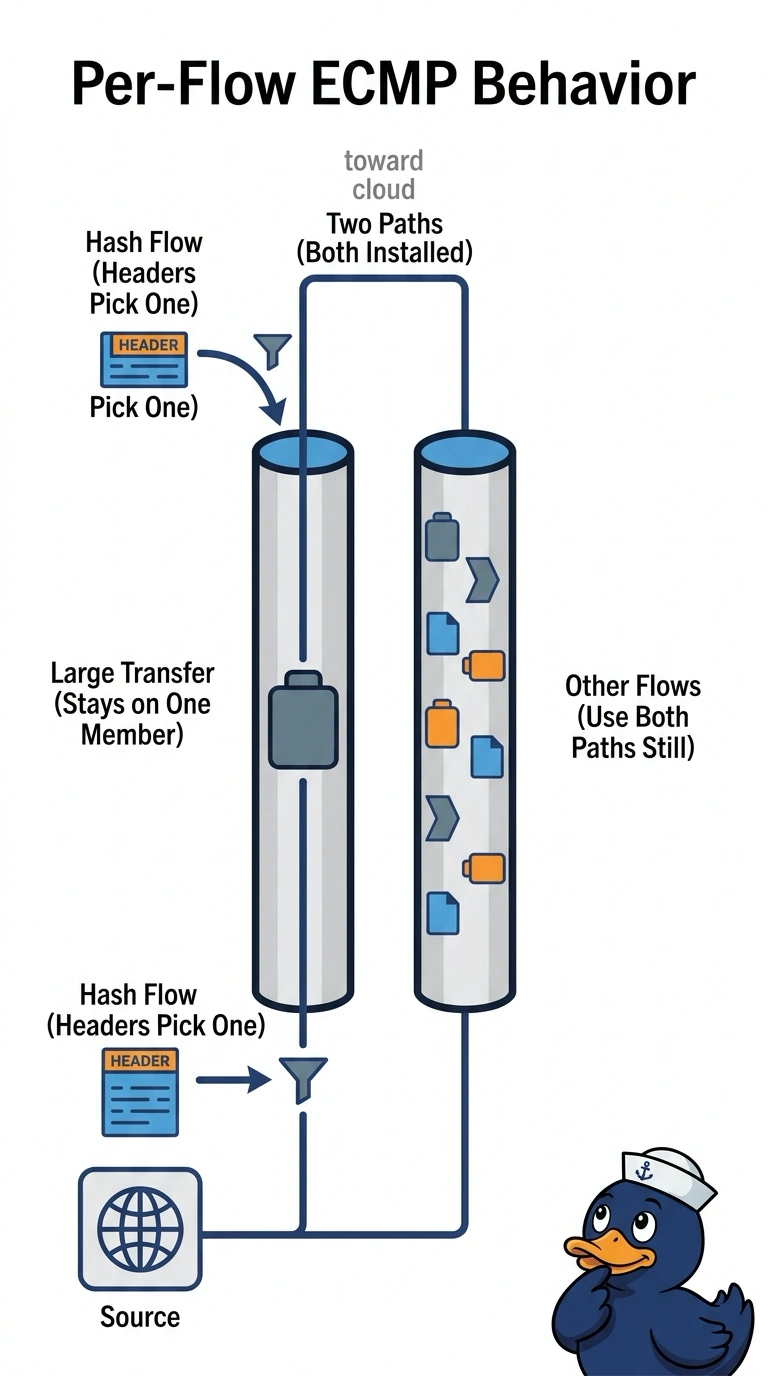
A convoy stays in one lane even when the highway has two. Both of your paths are installed, smaller flows use both, and one large transfer sits on a single path. With per-flow hashing, your transfer stays on one path instead of being split packet by packet.
Full Explanation
With per-flow ECMP, the forwarding implementation hashes selected packet-header fields to choose an installed next hop. A single large transfer is one flow, so it stays on one path while other flows hash onto both. That matches a studio edge where both paths are installed and smaller flows already use both. The second path is installed, so an explanation that says it is missing contradicts the forwarding state. A higher interior cost on the idle path would mean the paths were not equal-cost and the second path would not be installed for those smaller flows either. DNS names a destination; it does not pin one flow to one equal-cost next hop when other flows to the same cloud already use both paths. Exam caveat: per-packet balancing can spread one flow and can also reorder it; the usual provider behavior is per-flow. Operational check: look at the hash or the interface counters and confirm the large transfer's five-tuple stays on one member while a second flow moves on the other.