
A university research portal hosted in a service-provider cloud must keep resolving names when one DNS server fails. The sites already have two routing next hops, yet an outage of the single configured resolver still stops logins. Which design fits?
Select an answer to reveal the explanation.
Short Explanation
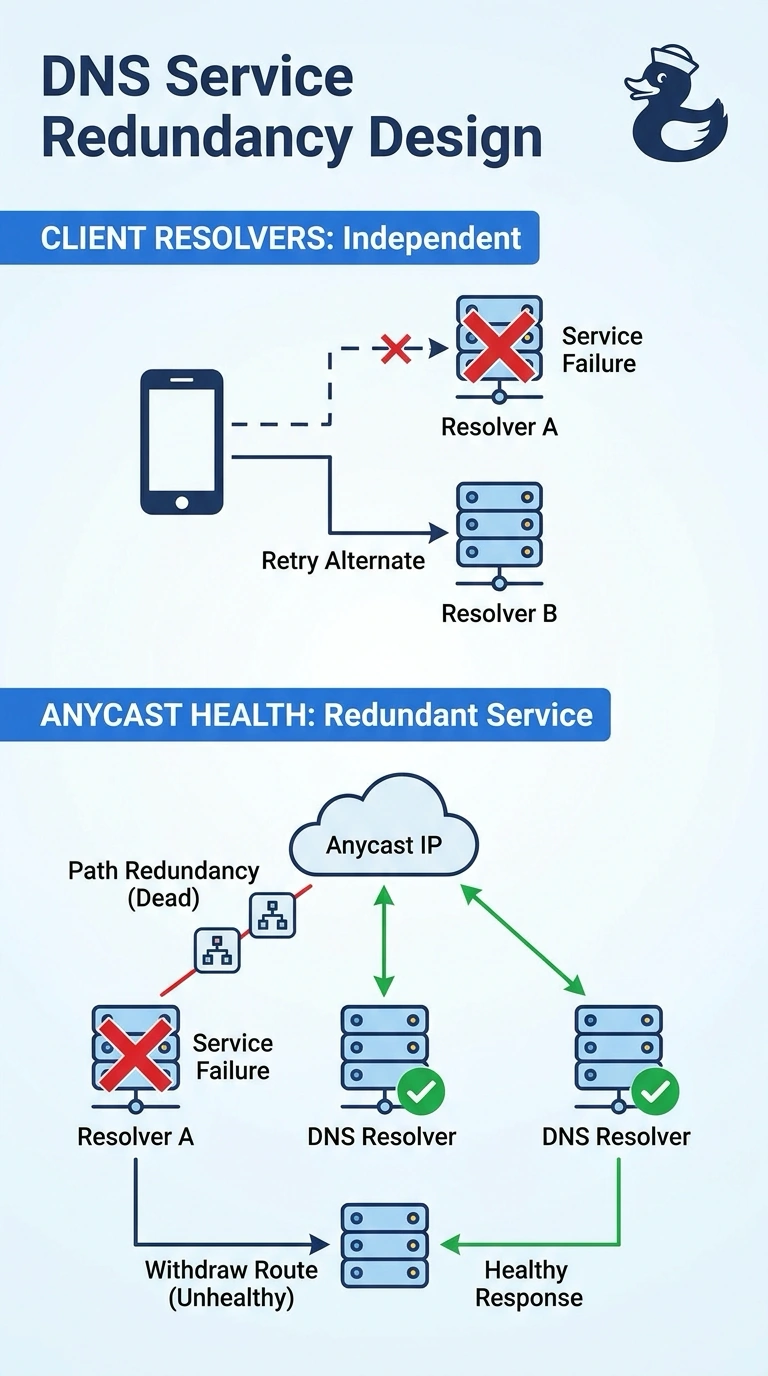
You are right to look beyond routing for this outage. You fix a DNS failure with a second resolver or anycast DNS, since another next hop still points to the same down server. You keep the portal working by giving clients another healthy place to send queries.
Full Explanation
Configure clients to use independent recursive resolvers, or deploy a redundant anycast recursive service whose routing responds to service health. This fits because name resolution fails at the service layer, not at the routing layer. With two resolver addresses configured, client stub resolvers retry the alternate address when the primary times out, restoring lookups without manual intervention. Routing selects an instance according to routing policy. Couple advertisements to service availability, or provide another mechanism that sends requests to a working instance when the local service fails. Adding a second routing next hop toward the same single resolver address fails by concept because path redundancy does not create service redundancy; if the lone server process is down, both paths still lead to a dead endpoint and queries still time out. Keeping only one resolver while depending on two WAN links makes the same category error, improving link survival while leaving a single point of failure for DNS itself. Hosts files can supply fixed mappings, but do not provide a redundant recursive DNS service and require manual updates. Exam caveat: routing and DNS redundancy solve different layers, so a second next hop never substitutes for a second resolver or anycast. Practical check: verify two resolvers or anycast on clients, then block one resolver and confirm lookups still succeed.