
Two equal-cost uplinks from a cloud fabric already sit in one OSPF area, and both next hops must stay in use. Which forwarding design fits?
Select an answer to reveal the explanation.
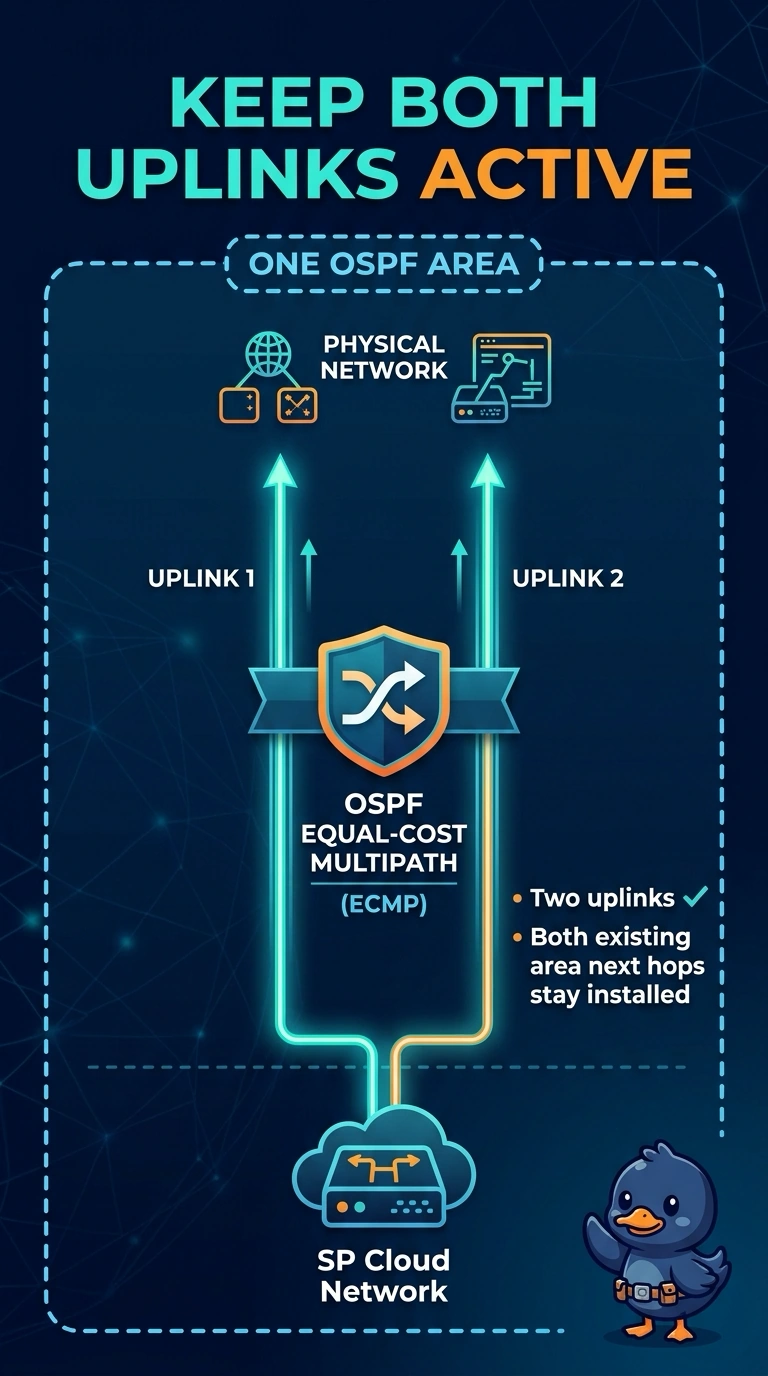
Short Explanation
Two open doors help only if you are allowed to walk through both. You keep OSPF equal-cost multipath so both area next hops stay installed. A single static default, BGP multipath with no BGP, and IS-IS on an OSPF fabric each throw away that pair.
Full Explanation
Equal-cost multipath keeps more than one next hop when the routing protocol computes equal costs. This fabric already has two equal-cost OSPF paths toward the physical network, so OSPF multipath is the design that uses both. One static default is a single next hop and is not equal-cost multipath. BGP multipath needs BGP, which this fabric is not using for these uplinks. IS-IS multipath applies to IS-IS, and these links are OSPF. OSPF equal-cost multipath so both existing area next hops stay installed toward the physical network is the design that meets this requirement. One static default route that pins the fabric to a single uplink and ignores the second hop is the wrong fit because one static default is a single next hop, so it is not equal-cost multipath across the two uplinks. BGP multipath on a fabric that has no BGP session and already has two OSPF equal costs is the wrong fit because BGP multipath needs BGP, and this fabric is already choosing two equal-cost paths with OSPF. IS-IS equal-cost multipath on links that are OSPF adjacencies and are not IS-IS adjacencies is the wrong fit because IS-IS multipath applies to IS-IS adjacencies, and these uplinks are OSPF rather than IS-IS. Exam caveat: Equal-cost multipath uses the paths the protocol already treats as equal, and a change in cost on one uplink can leave only one next hop installed. Operational check: Confirm the OSPF routing table shows both uplinks as next hops for the same destination, and confirm no static default has replaced that pair.