
Two application teams each have a virtual private cloud and need a controlled path between them without joining the provider underlay. Which design fits?
Select an answer to reveal the explanation.
Short Explanation
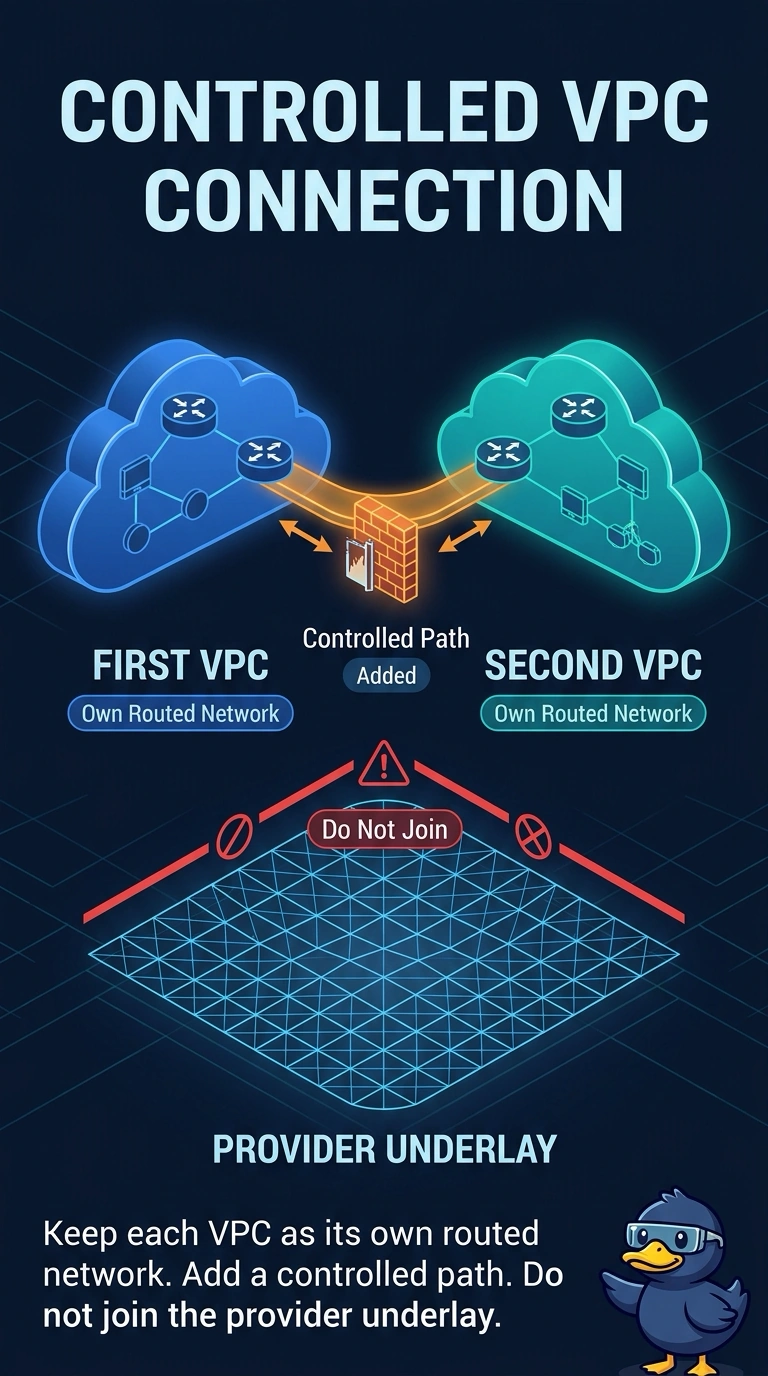
Two apartments can share a locked hallway without knocking down the walls. You keep each virtual private cloud as its own routed network and add a controlled path between them. The provider underlay, one flat VLAN across both teams, and a single broadcast domain erase that boundary.
Full Explanation
A virtual private cloud is the tenant routed and segmented network, with its own subnets and a controlled path out. A controlled path between two such networks keeps each routing table and each boundary. The provider underlay is not the tenant network. One flat VLAN stretched across both teams is not a virtual private cloud. Collapsing every subnet into one broadcast domain removes the routed segmentation the teams already have. Keep each virtual private cloud as its own routed network and add a controlled path between them is the design that meets this requirement. Merge both teams into the provider underlay so their routes sit in the shared provider routing table is the wrong fit because the provider underlay is not the tenant network, and merging into it gives up each team's own routing table. Stretch one flat VLAN across both teams and call that stretch a virtual private cloud is the wrong fit because one flat VLAN stretched across both teams is not a routed virtual private cloud with its own subnets. Collapse every subnet in both clouds into a single broadcast domain with no routed boundary is the wrong fit because a single broadcast domain removes the routed segmentation each virtual private cloud was built to keep. Exam caveat: A controlled path between two virtual private clouds still needs its own route policy, and it does not make either cloud part of the provider underlay. Operational check: Verify nonoverlapping CIDRs for direct VPC peering, routes to the peer prefixes in both directions, and access rules for the intended traffic.