
A university research lab needs its own isolated network inside a service-provider cloud, with private subnets for compute and storage plus a single controlled path to the Internet, separate from the provider transport. What provides that tenant space?
Select an answer to reveal the explanation.
Short Explanation
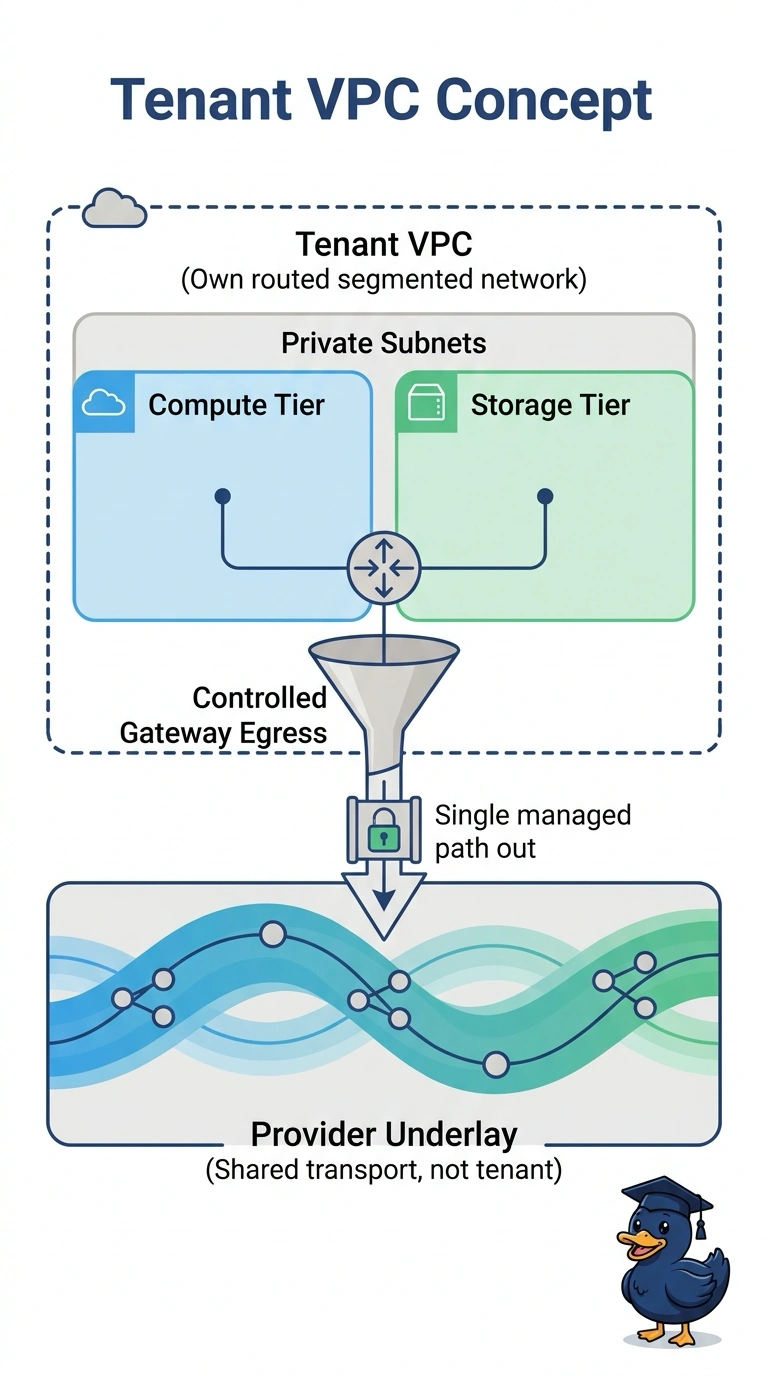
Think of it like you renting a walled suite inside a large building. You get your own rooms and one guarded front door, while the building hallways stay separate. That suite is your virtual private cloud.
Full Explanation
A virtual private cloud with tenant subnets and controlled gateway egress is the tenant's own routed and segmented network inside the cloud. It provides private address space divided into subnets for tiers such as compute, storage, and management, with internal routing between them. For Internet access from private IPv4 subnets, configure the appropriate NAT or inspection path and route tables. On-premises access uses the supported private connectivity and routing. Isolation is logical, so tenants share infrastructure yet stay separate. The provider underlay fabric that carries all tenants between cloud nodes is the wrong fit because it is shared transport, not per-tenant space; it moves traffic without defining tenant subnets or egress policy. Dedicated physical routers per tenant with direct Internet circuits bypassing the cloud is the wrong fit: Dedicated routers and circuits bypass the requested tenant network inside the cloud and introduce infrastructure the requirement does not need. A flat shared VLAN stretched across tenants without routing or egress control is the wrong fit because it merges broadcast domains, provides no segmentation, and offers no controlled egress. Exam caveat: VPC equals tenant overlay with routing and policy, underlay equals provider transport. Operational check: verify VPC CIDR, subnets, route tables, and egress before attaching workloads.