
A factory virtual firewall must keep working if one upstream provider fails. Both current links ride the same metro fiber into that one carrier. Which change is real multi-homing?
Select an answer to reveal the explanation.
Short Explanation
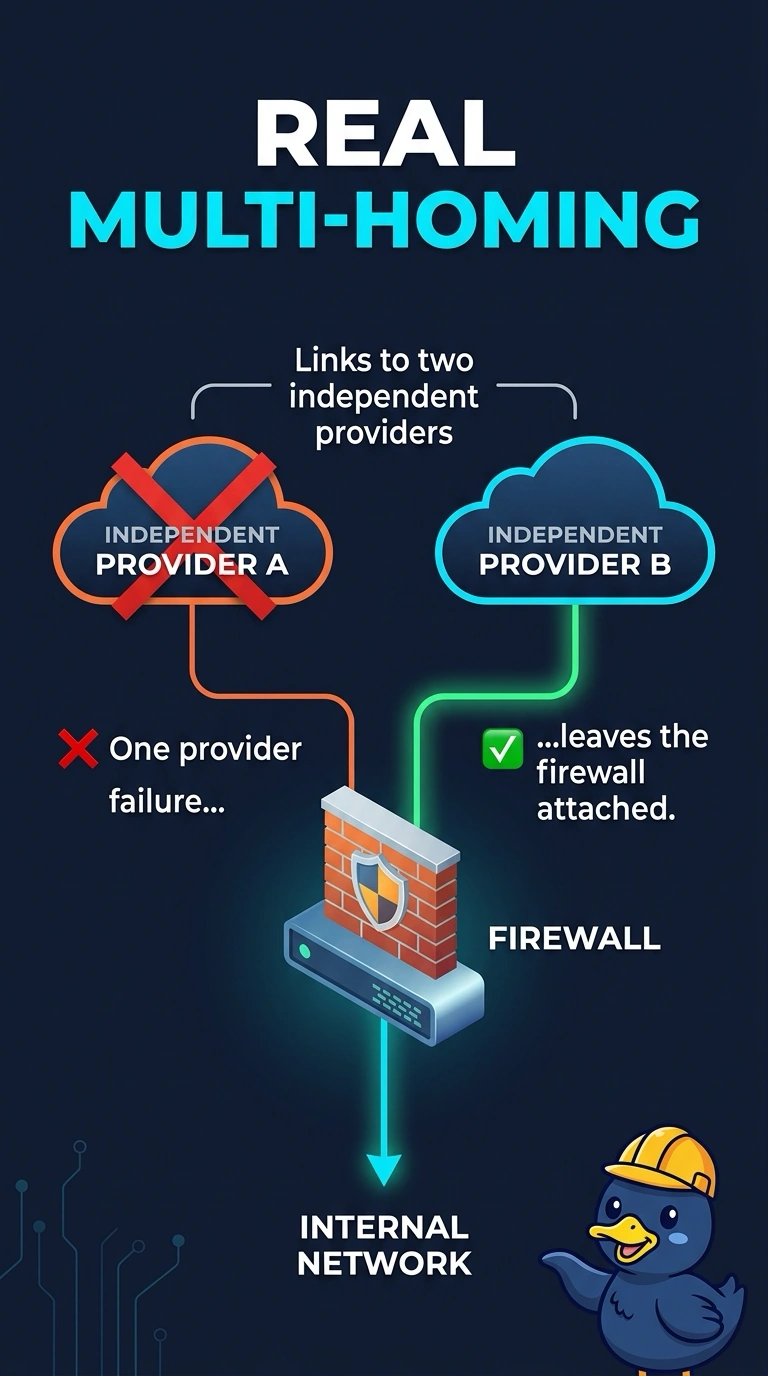
Two lanes on the same bridge still leave you stranded when that bridge drops. You home the factory firewall to two providers that do not share one upstream failure. A second circuit on the same fiber, multihoming inside one provider, and multipath to a single provider all share that fate.
Full Explanation
Multihoming connects the site or device through multiple attachments. To survive the failure in this scenario, put the attachments in separate failure domains and verify that traffic can use either path. That is why links to two independent providers meet the requirement: loss of one provider leaves the firewall attached via the other. A second circuit on the same metro fiber and the same provider core fails together with the existing path because it shares the fiber and the provider core. EVPN link aggregation onto two edges that still belong to that one upstream provider survives an edge loss but still fails when that provider itself is the outage. Equal-cost multipath across two links that both leave through that same one provider improves bandwidth use but still depends on that single provider. For a stateful firewall, verify session continuity separately from reachability. Exam caveat: two links count only when they avoid the upstream failure you care about. Operational check: confirm different providers on independent fiber and that loss of either leaves one path up.