
A video platform already peers BGP from its cloud edge to three provider routers over equal-cost links and needs all three next hops used for forwarding. The three BGP paths meet the platform’s multipath eligibility rules, and the forwarding platform supports at least three paths. Which design installs more than one next hop?
Select an answer to reveal the explanation.
Short Explanation
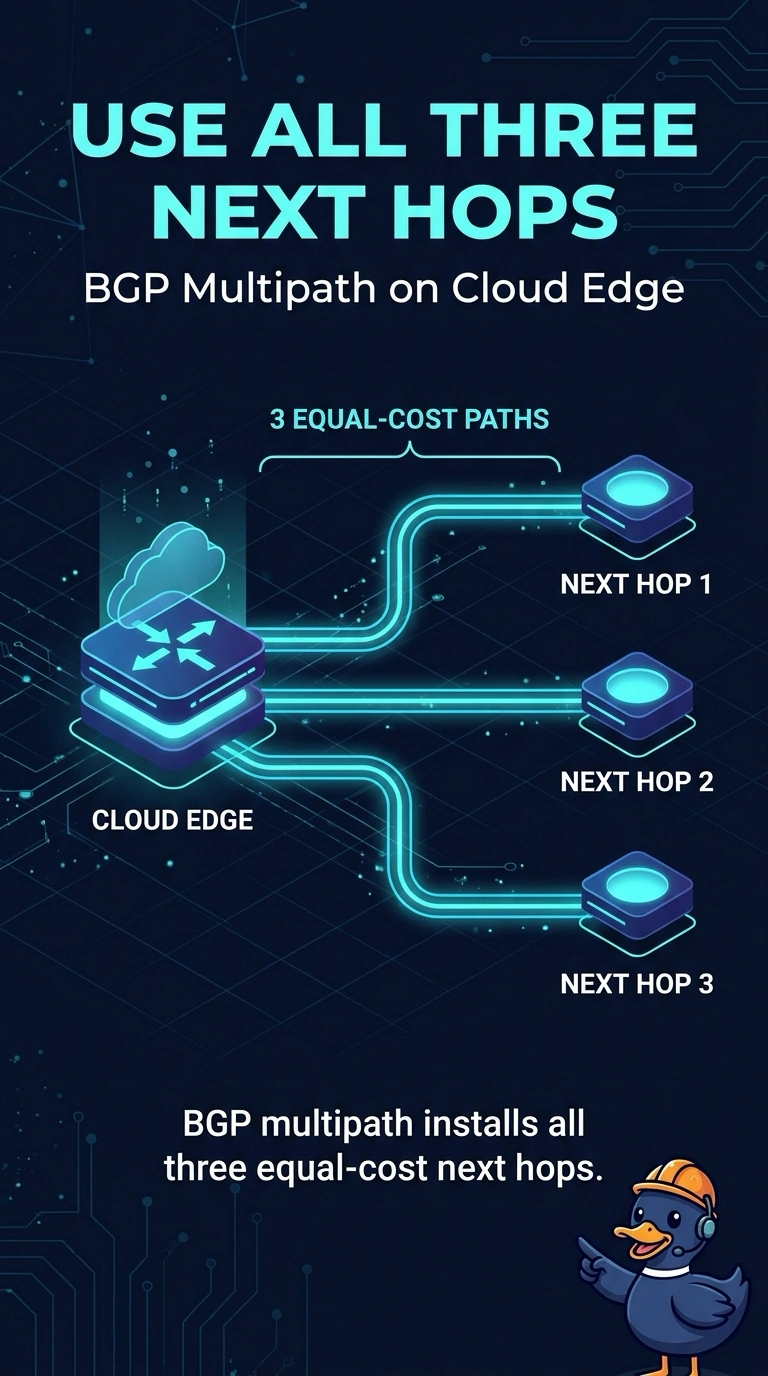
You can put all three equal-cost BGP paths to work with BGP multipath, which installs all three next hops for forwarding. A single static default uses one provider router, IS-IS multipath does not apply to this BGP-only edge, and DNS anycast steers clients rather than adding router next hops.
Full Explanation
Equal-cost multipath keeps more than one next hop in the forwarding table for the same destination. Because this cloud edge already has three equal-cost BGP peerings to provider routers, BGP multipath can install all three BGP next hops and use them for forwarding. A single static default pointed at one provider router installs only that next hop, leaving the other two links unused. IS-IS equal-cost multipath would apply if the provider next hops were learned through IS-IS, but this edge peers with the providers using BGP and does not run IS-IS. DNS anycast spreads clients across site addresses; it does not install additional router next hops on the cloud edge. The design that meets the requirement is BGP multipath installing all three equal-cost BGP next hops. Exam caveat: Configure the address family for at least three eligible paths; equal link cost or preference alone is insufficient. Practical check: Inspect the cloud edge’s route and forwarding entries for the destination and confirm that three BGP next hops are installed, rather than a single static default pinning traffic to one provider router.