
A regional bank must keep its payment-verification VNF online if any single provider or access device fails. What design fits that requirement?
Select an answer to reveal the explanation.
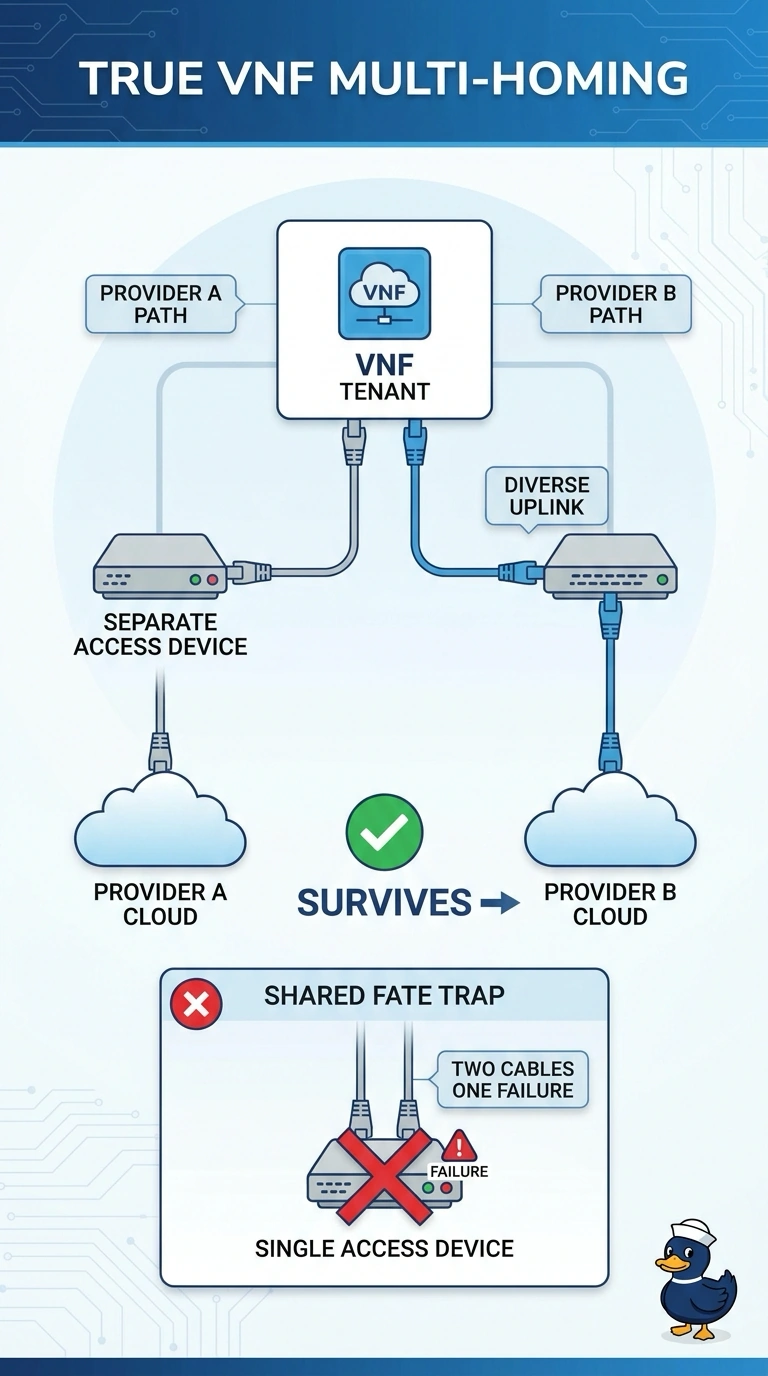
Short Explanation
Think of two separate roads into town — you can still arrive if one is closed. You give the VNF two independent providers on separate devices so one failure cannot isolate it. A lone device or two cables sharing one upstream still leaves you with a single fate.
Full Explanation
Multihoming provides multiple attachments. Surviving the specified provider or access-device failure requires separate failure domains, working routing in both directions, and sufficient capacity on the surviving path. Connecting to two independent providers through separate access devices with diverse uplinks meets that test because each side has its own device, uplink, and provider path, so loss of one still leaves a working forwarding path for inbound and outbound traffic. Attaching to a single provider through one access device with no backup fails that test because the lone device and uplink are a single point of failure; any hardware, link, or provider outage removes the only attachment. Running two links to one access device served by a single provider circuit also fails because the pair shares one upstream fate; despite having two cables, a failure of that common device or circuit takes both down together, which leaves the shared access device and circuit as single points of failure. Keeping the workload inside one fabric with only internal paths fails for a different reason: internal load-sharing improves east-west resilience but provides no separate provider attachment, so an egress or provider failure still isolates the tenant. Design checks should verify diverse devices, uplinks, and provider paths rather than counting cables.