
At a stadium, name lookups fail while the next hop still forwards and the application load balancer still passes health checks. A second resolver is idle. What should take the lookups?
Select an answer to reveal the explanation.
Short Explanation
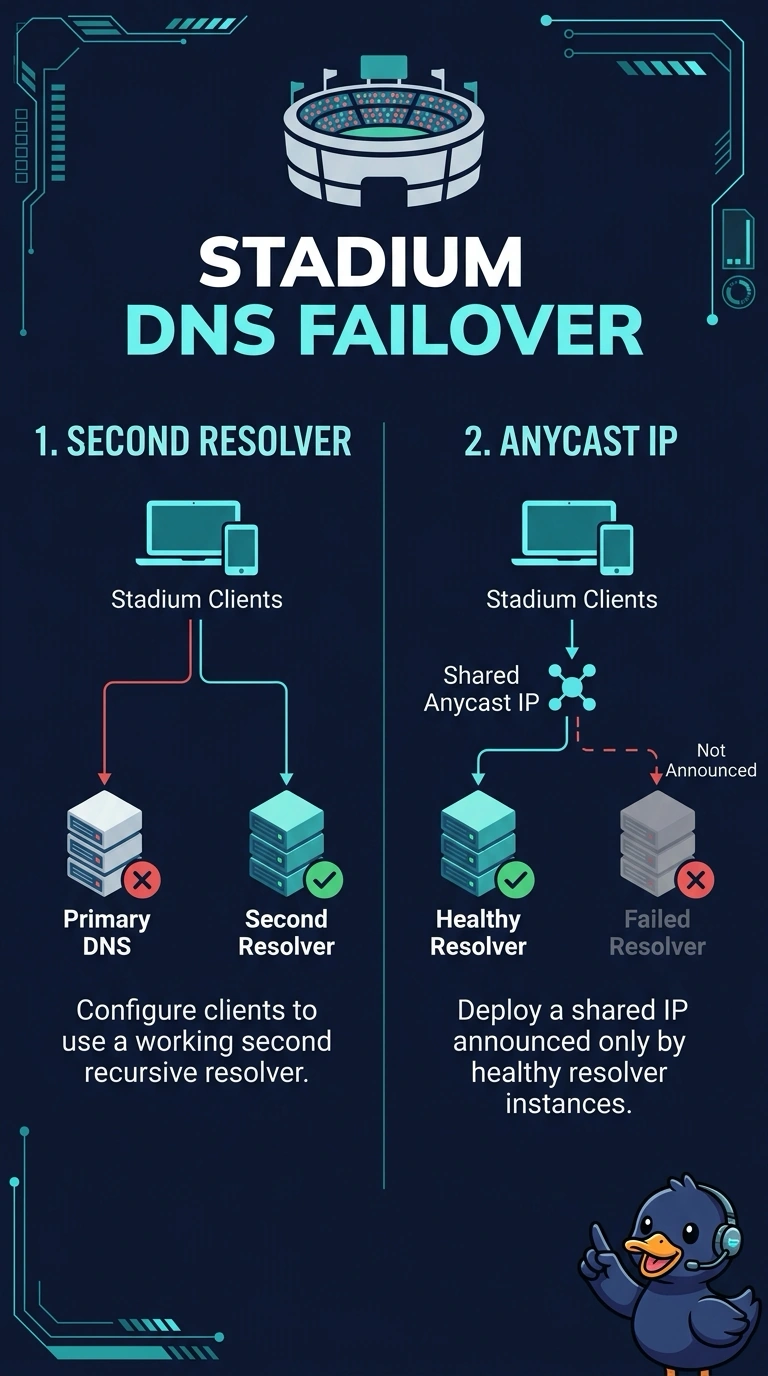
Think of a second phone book when you cannot look up a name, even if the roads and ticket window are fine. You configure clients to use the working second recursive resolver, or use a shared resolver IP announced only by healthy instances while routing and the balancer stay healthy.
Full Explanation
DNS, routing, and load balancing fail independently, so the spare must match the failed function. Name lookups are failing while the next hop still forwards and the application load balancer still passes health checks, with a second resolver idle. Configure clients to use the working second recursive resolver, or deploy a shared resolver IP announced only by healthy resolver instances, which restores resolution without changing healthy forwarding or balancing. Anycast uses a shared service address and routing; advertising the address alone does not detect failed DNS service, so advertisement must follow resolver health. A second routing next hop for a forwarding path that is already reaching the stadium is the wrong fit because it addresses a routing failure, while forwarding toward the stadium is already working. Another load-balancer node for a balancer that is already passing its health checks is the wrong fit because it addresses balancer failure, while checks show the balancer is healthy. An Ethernet bundle from the stadium edge to two provider routers that does not serve names is the wrong fit because it diversifies attachment and does not answer lookups.