
A cloud fabric facing a mint runs IS-IS. Two paths have equal cost, yet the edge installs only one next hop. What should the edge install?
Select an answer to reveal the explanation.
Short Explanation
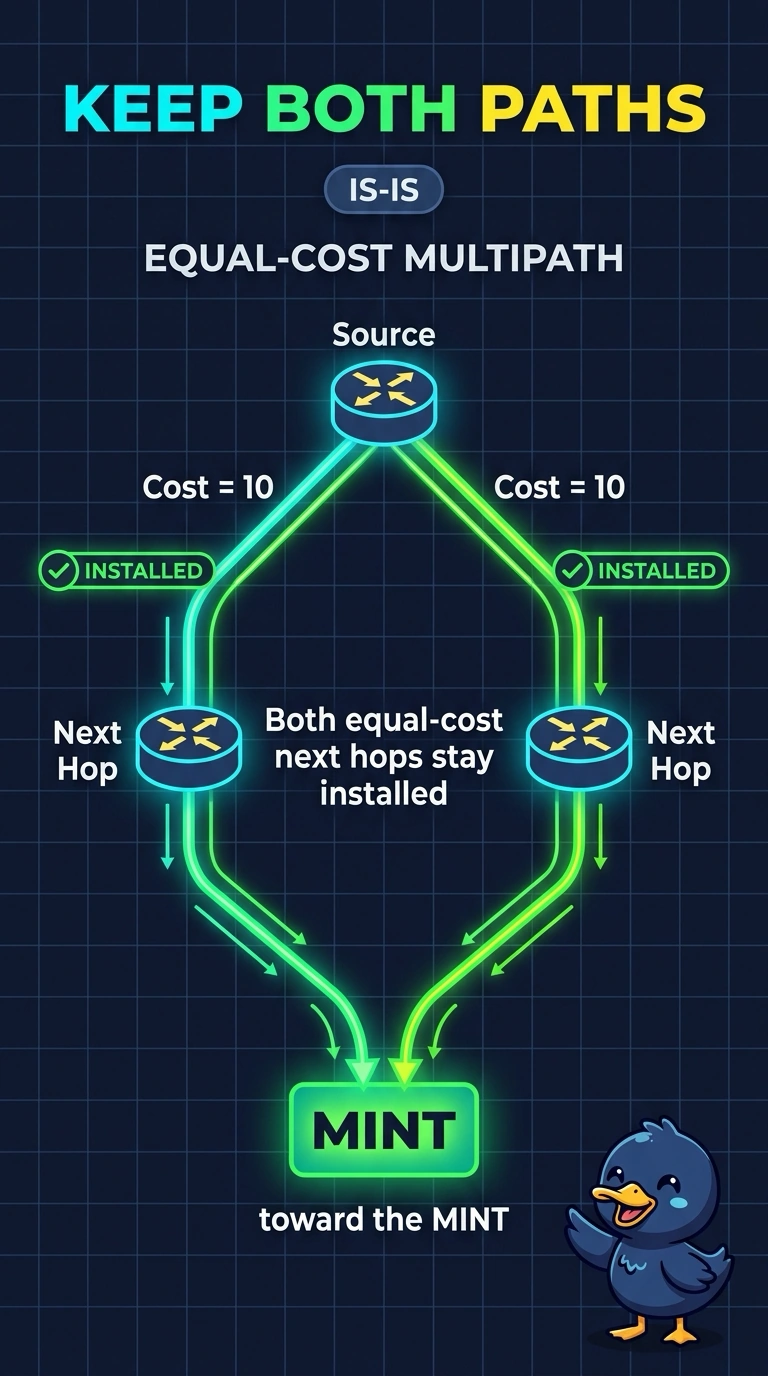
Two equal lanes do no good if the driver is allowed to pick only one. You install IS-IS equal-cost multipath so both next hops stay in use toward the mint. One static default, BGP multipath, and OSPF equal-cost multipath do not keep both of those IS-IS hops.
Full Explanation
Equal-cost multipath keeps more than one next hop when the costs match. This fabric runs IS-IS, and two paths toward the mint already have equal cost, but the edge installs only one. The edge should install IS-IS equal-cost multipath so both next hops stay up. A static default is one hop. BGP multipath needs BGP, which is not how these paths are learned. OSPF multipath is a different protocol than the one this fabric runs. IS-IS equal-cost multipath so both equal-cost next hops stay installed toward the mint is the design that meets this requirement. One static default that replaces the two IS-IS paths with a single next hop is the wrong fit because one static default is a single next hop and does not keep both equal-cost IS-IS paths in use. BGP multipath toward next hops that this fabric does not learn through BGP is the wrong fit because BGP multipath needs BGP next hops, and this fabric learns the two paths with IS-IS instead. OSPF equal-cost multipath on a fabric that learns these paths with IS-IS is the wrong fit because OSPF equal-cost multipath applies to OSPF routes, and the mint fabric here is running IS-IS. Exam caveat: One static default is not equal-cost multipath. Installing it would collapse the two IS-IS paths toward the mint back to only a single next hop. Verify that the IS-IS route computation produces equal-cost next hops for the same prefix and that the configured maximum-paths, RIB, and forwarding hardware permit both.