
A marina virtual broadband gateway holds two provider sessions, and both leave through one virtual NIC on one compute host. A host failure drops both sessions. What makes this attachment multi-homed?
Select an answer to reveal the explanation.
Short Explanation
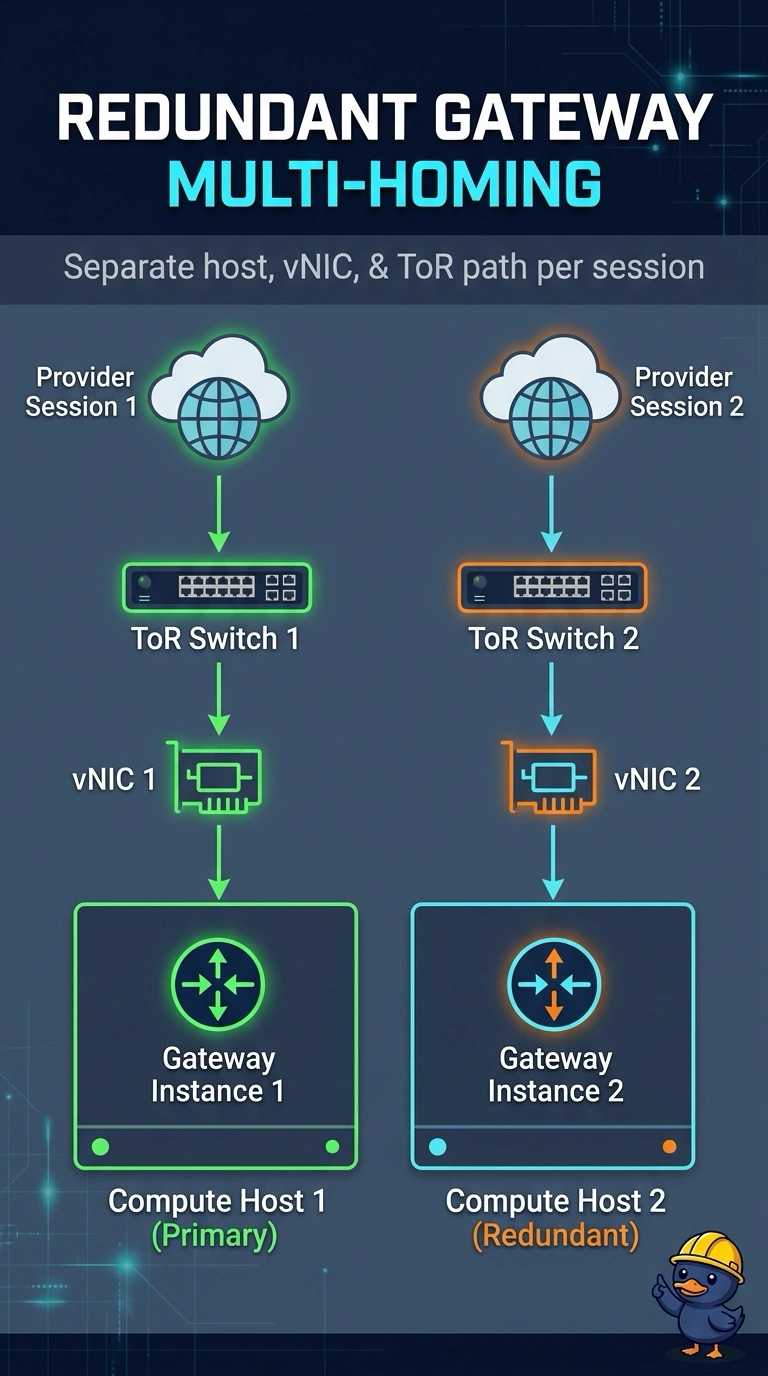
Think of two tickets on the same bus: you still get stranded when that bus breaks down. For multi-homing, deploy a redundant gateway on a second host with its own vNIC and ToR path, and terminate the other provider session there so one host cannot drop both. A second address on the same NIC, two static routes to one upstream device, or a link bundle that stays on the same host and upstream device still shares the failure.
Full Explanation
Multi-homing attaches a function to two independent devices so one failure does not isolate it. Both marina provider sessions currently leave through one virtual NIC on one compute host, so a host failure takes both down. Deploy a redundant gateway instance on a second compute host with a separate vNIC and ToR path, then terminate the other provider session on that instance. This creates an attachment that can remain live after the original host fails. A second address on the same virtual NIC still leaves both providers dependent on that one host, so its failure takes both sessions down. Two static routes on the same guest toward the same single upstream device still share that device’s failure and do not provide independent attachment. A bundle of two links that still ends on the same host and upstream device likewise drops both sessions together if that shared host or device fails. Exam caveat: Two provider names alone do not make a setup multi-homed when both sessions leave through one host and one virtual NIC. Practical check: Fail the original host and confirm the redundant instance on the second host stays up and its provider session remains available.