
A ferry terminal connects to two provider edges in the same hut, and both edges reach the core through one shared fiber splice. A cut at that splice isolates the terminal. Why does this dual-homed design fail to survive the splice cut?
Select an answer to reveal the explanation.
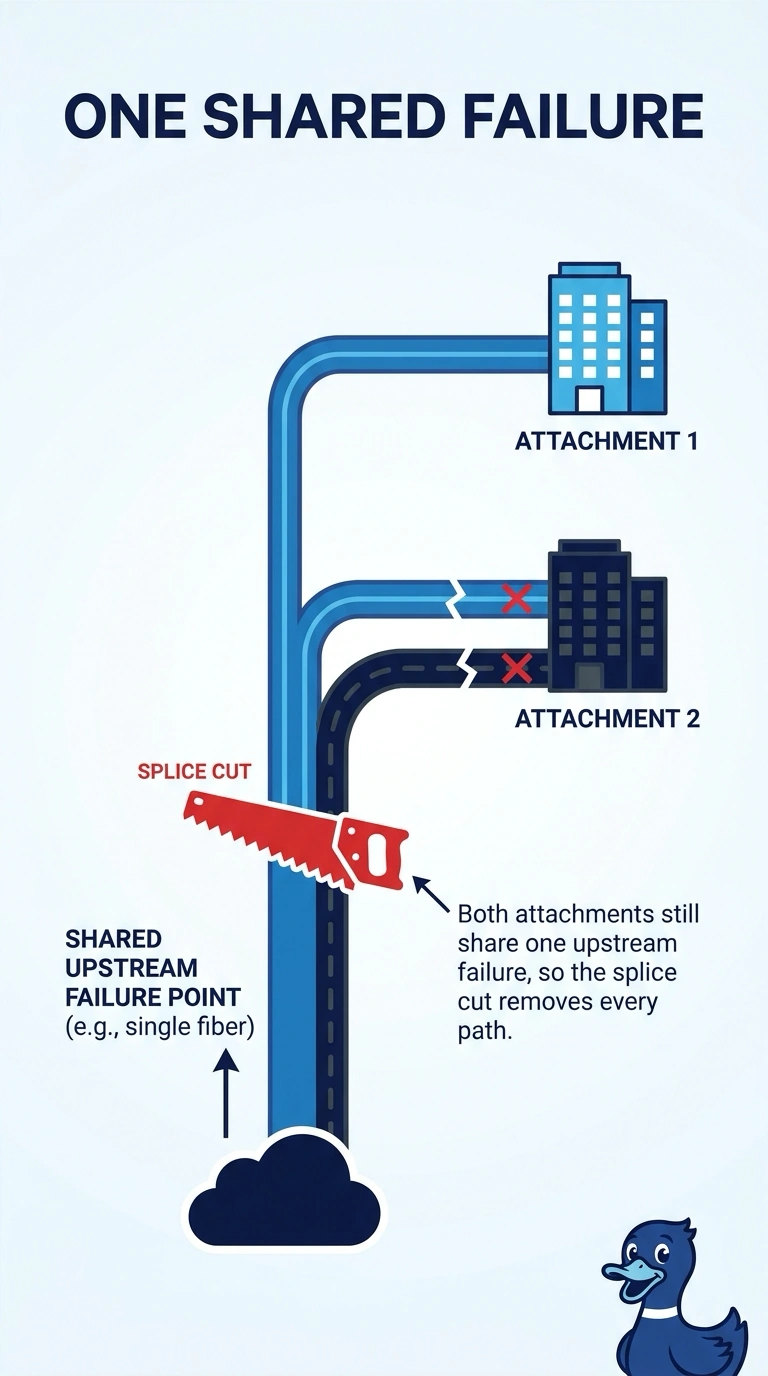
Short Explanation
Two doors on the same hallway still trap you when the hallway collapses. The terminal has two edges, and both of them depend on one splice toward the core. Both attachments still share the splice, so neither gives you a surviving path around that cut.
Full Explanation
Multi-homing provides multiple attachments; protection against a particular failure requires a path outside that failure domain. These two edges look diverse from the terminal, but both cross one fiber splice to reach the core. When that splice is cut, every path is gone, so the multi-homed design does not survive that upstream failure. Designated-forwarder election is an EVPN behavior that picks one edge to send certain flooded traffic; it does not describe why a fiber cut isolates the site, and it does not block the terminal on purpose. Equal-cost routing can use two edges in one hut when the paths are otherwise eligible; sharing a building does not by itself forbid two next hops. A second DNS name does not create a second physical path, and the isolation here is a broken splice, not a name. Exam caveat: the same pair of edges can still be multi-homed against a single edge reboot; the missing diversity is specifically the shared splice. Operational check: draw the upstream of each edge and confirm there is a failure that hits both before claiming resilience to that shared failure.