
A botanical garden router is cabled to two provider edges. Both links forward and a loop has formed. The garden wants one Ethernet bundle so either edge can fail without a loop. What design fits?
Select an answer to reveal the explanation.
Short Explanation
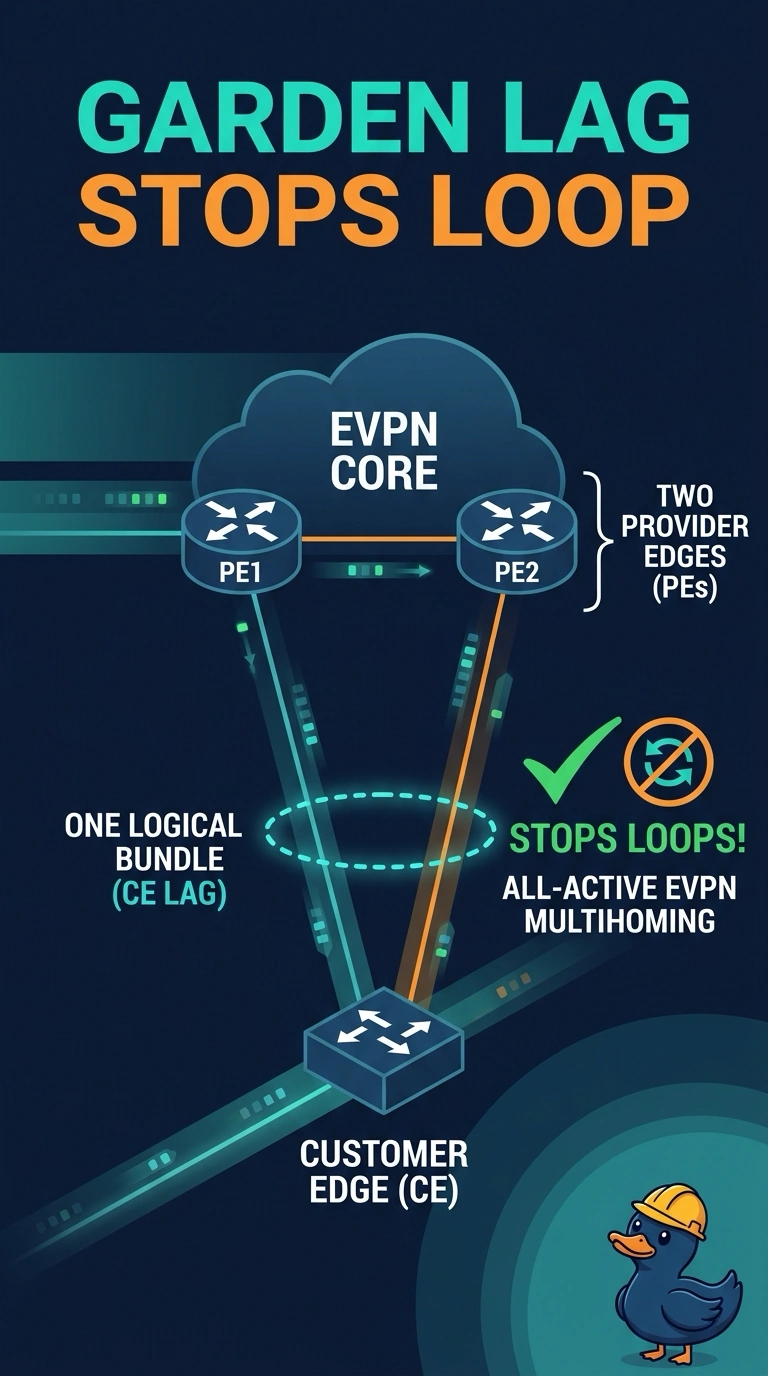
Think of two doors made into one doorway for you. You want all-active EVPN multihoming for one CE LAG across the two PEs so either edge can fail without a loop. A single-homed bundle, separate peerings, and shutting a link do not give you that single bundle.
Full Explanation
Configure all-active EVPN multihoming for one CE LAG across the two PEs is correct because it presents the garden router attachment as one logical Ethernet segment while both provider edges stay active. Use a common ESI and consistent LACP settings. EVPN split horizon and designated-forwarder behavior prevent duplicate flooding and loops on the shared Ethernet segment. That directly resolves the current condition where both links forward independently and a loop has formed, while preserving resilience if either edge fails. A single-homed port channel that uses only one provider edge and dies with that edge is the wrong fit because attachment to only one edge leaves no second active path, so failure of that edge isolates the garden router. Two separate routed peerings that do not form one Ethernet bundle for the garden is the wrong fit because independent Layer 3 attachments do not create a single loop-free LAG and do not share the Ethernet segment state needed for multihoming. Shutting the second link so the loop stops and that provider edge stays unused is the wrong fit because disabling capacity removes redundancy the garden requires and leaves only a single active edge.