
A regional hospital network connects its imaging archive to a service-provider cloud fabric over two equal-cost uplinks and must keep both next hops active for resilience. Both uplinks advertise the same destination through BGP, and their paths satisfy this router’s multipath eligibility rules. Which design keeps more than one next hop alive?
Select an answer to reveal the explanation.
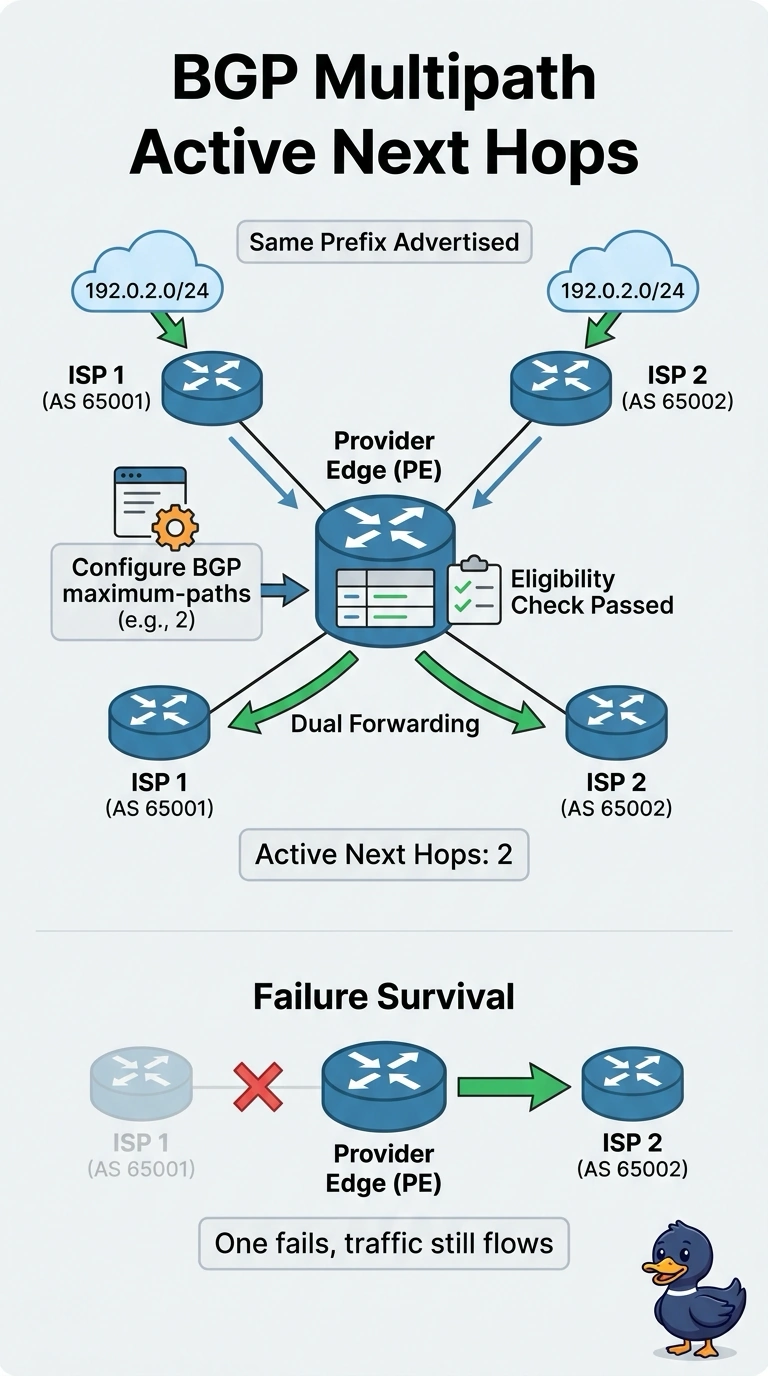
Short Explanation
You want both uplinks active so you keep forwarding if one fails. When both paths are eligible, you configure BGP maximum-paths for at least two eligible paths to keep two next hops programmed. That way you get simultaneous forwarding instead of relying on a single static next hop.
Full Explanation
Configuring BGP maximum-paths for at least two eligible paths to the destination is correct because when both uplinks advertise the same destination through BGP and their paths satisfy this router’s multipath eligibility rules, the router can install multiple next hops for the same prefix and use them in parallel, so if one path fails another remains programmed. Forwarding can continue on the surviving path without installing a new route type, provided policy and best-path attributes allow equal cost. A single static default route toward one fabric next hop installs only one next hop, so failure of that hop or interface leaves no alternate and requires manual or dynamic recovery. Two uplinks with load sharing disabled leave a spare that is not programmed for forwarding. An inactive backup can provide resilience after convergence. Multipath additionally permits simultaneous forwarding over eligible paths. A single IGP path with equal-cost balancing disabled has the same weakness, because only one next hop is installed despite parallel links. The exam caveat is that having two cables is not enough; the control plane must keep multiple next hops alive in the RIB and FIB. As a practical check, confirm that the IP routing table and BGP table show two next hops, then shut one uplink and verify traffic continues over the remaining hop.