
A rail cloud separates its VIM controller/API services from forwarding nodes. Existing flows require no controller exchange during the planned active-to-standby handoff, and forwarding nodes remain healthy. What does that controller failover cover?
Select an answer to reveal the explanation.
Short Explanation
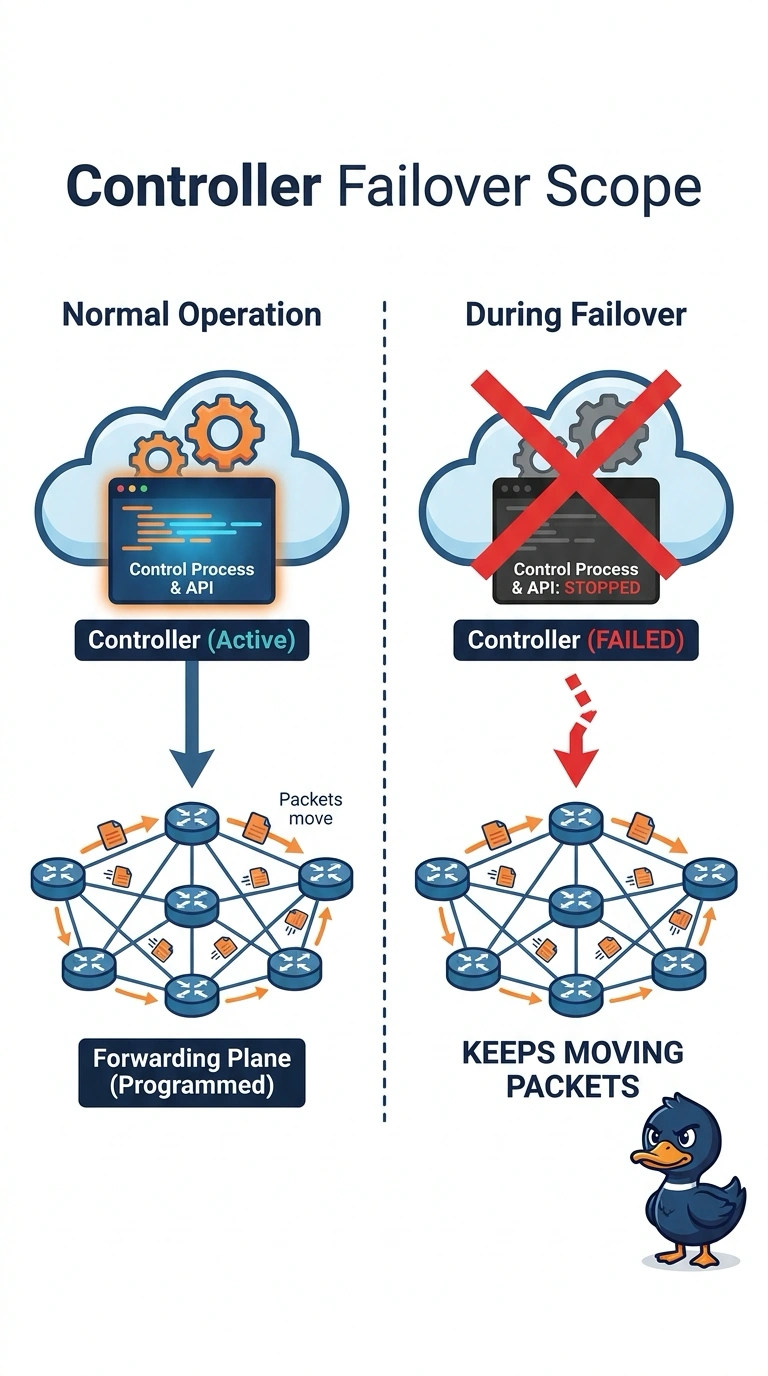
Swapping the dispatcher does not stop trains that already have a track. You are failing over the controller inside this cloud, and the designer wants to drain users as if every packet will freeze. The failover covers the control process; forwarding that is already programmed keeps going.
Full Explanation
The handoff restores controller/API service on the standby. API requests can briefly pause during takeover. Existing flows continue in this stated design because their forwarding nodes and programmed state remain independent of the controller handoff. This separation is why a planned failover covers management, scheduling and API availability rather than the user data path. The idea that every user packet stops until the election finishes treats the controller as if it forwards each packet, which confuses control plane with data plane in this stated architecture. Top-of-rack links do not move to another rack because a controller process failed over; physical cabling and switching remain where they are and are not rehomed by an API election. Name service is a different system from VIM control; a controller election does not renumber application names or require a new naming plan. Exam caveat: a long total loss of both controllers can eventually age out some programmed state, but a planned failover to a live standby is not that outage. Operational check: fail the active controller in a maintenance window and confirm existing flows continue while a new API call succeeds against the standby.