
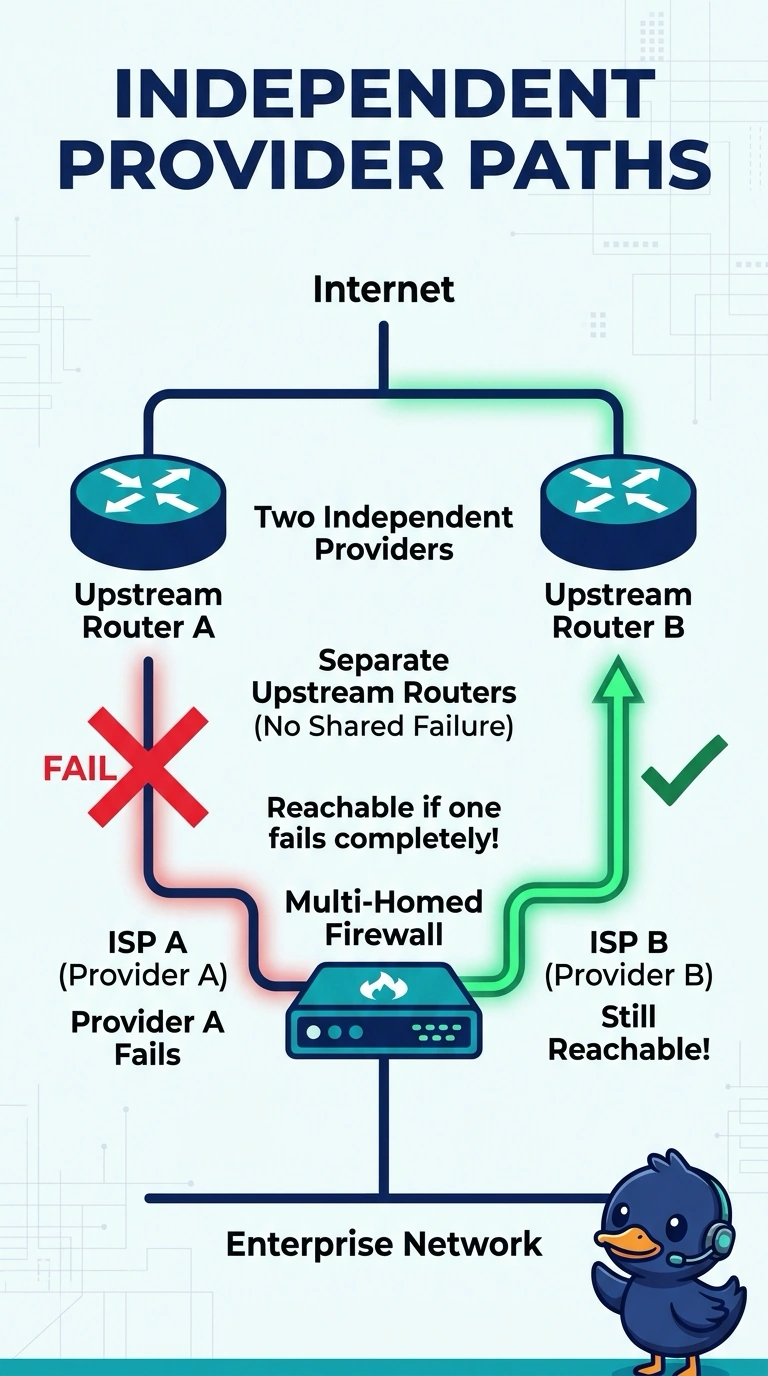
A clinic virtual firewall must stay reachable if one upstream provider fails completely. The two attachments must not share one upstream router. Which design fits?
Select an answer to reveal the explanation.
Short Explanation
Think of two separate power feeds keeping your lights on when one utility goes dark. You put your two firewall attachments in separate failure domains so one provider loss still leaves you reachable, and you verify traffic can use either path. Two links sharing one router, one provider's bundle, and one switch still share a fate, so you must check session continuity separately from reachability.
Full Explanation
Multihoming connects the site or device through multiple attachments. To survive the failure in this scenario, put the attachments in separate failure domains and verify that traffic can use either path. That is why multi-homing the firewall to two independent providers that do not share one upstream failure meets the requirement, because one complete provider failure leaves the other attachment usable. Two physical links from the firewall that both terminate on one upstream router at the same provider is the wrong fit because both cables depend on that same router, so the router remains a single shared failure. EVPN link aggregation toward two edges of a single provider, presented as one logical bundle is the wrong fit because the bundle can survive an edge loss inside that provider but still fails when the whole provider fails. A second virtual NIC on the same compute host, aimed at the same top-of-rack switch is the wrong fit because the new NIC still depends on the same host and the same switch. Exam caveat: Two links are not multi-homing when they share one upstream failure. Operational check: Take one provider attachment down and confirm the firewall stays reachable through the other provider, and that the two paths do not meet on one upstream router. For a stateful firewall, verify session continuity separately from reachability.