
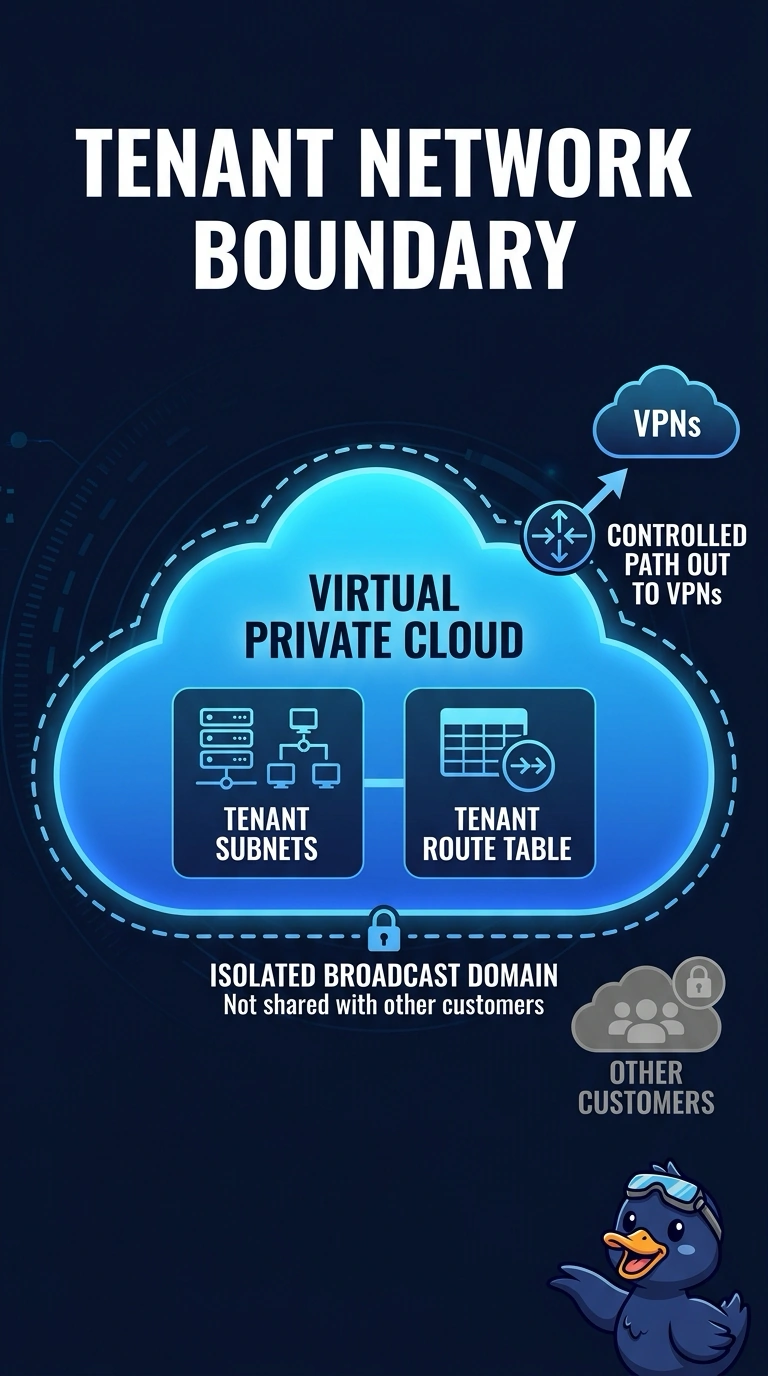
A tenant in a provider cloud needs its own subnets, its own route table, and a controlled path out to its VPNs. The tenant must not share one broadcast domain with other customers. Which construct is that?
Select an answer to reveal the explanation.
Short Explanation
You need your own subnets, route table, and controlled path out, without sharing a broadcast domain. A virtual private cloud gives your tenant that distinct routed network. The provider underlay, a flat VLAN for every tenant, and a public subnet shared by all tenants do not provide that tenant-specific network.
Full Explanation
A virtual private cloud is the tenant’s own routed network inside the cloud, with its own subnets, route table, and controlled path out to its VPNs. It meets the requirement because the tenant’s network is distinct from other customers’ broadcast domains. The provider underlay that carries every tenant between the compute hosts is provider transport, not the tenant’s routed network; it does not give the tenant its own subnets or route table. One flat VLAN stretched across the cloud for every tenant creates a shared broadcast domain, contrary to the requirement. A single public subnet shared by all tenants does not give this tenant its own subnets or route table for controlling its path out. Exam caveat: Having a virtual private cloud and its own route table does not by itself prove that the path to the tenant’s VPNs is configured or working. Practical check: In the tenant view, confirm that the tenant’s subnets and route table are present, that the route table directs traffic toward the intended VPN path, and that another tenant cannot ARP for hosts on those subnets.