
A customer router must dual-home to two provider edges as one logical Ethernet bundle so either edge can fail without creating a loop. Which design fits?
Select an answer to reveal the explanation.
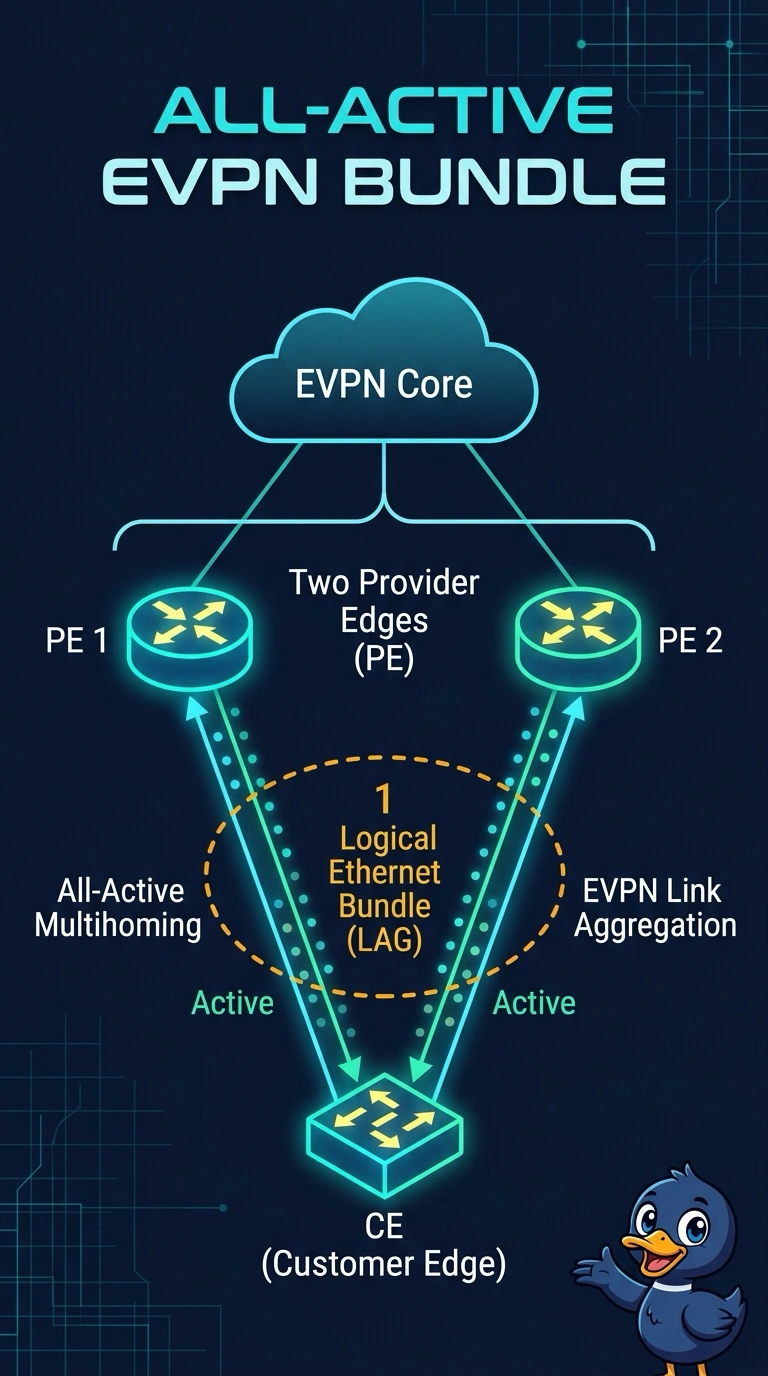
Short Explanation
Two doors that act as one entrance let you through when either door is closed, without walking in a circle. You use EVPN link aggregation when the customer needs those two provider edges as one logical bundle. A single-homed port channel, two independent uplinks, and a flooded VLAN without loop control do not build it.
Full Explanation
Configure all-active EVPN multihoming for one CE LAG across the two PEs lets one customer router dual-home onto two provider edges as a single logical bundle. Use a common ESI and consistent LACP settings. EVPN split horizon and designated-forwarder behavior prevent duplicate flooding and loops on the shared Ethernet segment. Either edge can fail without leaving the customer single-homed and without creating a loop. A single-homed port channel that bundles member links toward only one of the provider edges is the wrong fit because it bundles links on one edge only, so the customer loses attachment if that edge fails. Two independently routed provider attachments with no shared Ethernet bundle for the customer is the wrong fit because it provides two separately routed uplinks and does not present one logical Ethernet bundle. One VLAN flooded toward both provider edges with no multihoming control to stop a loop is the wrong fit because it floods one VLAN toward both edges and has no control to block the resulting loop. Exam caveat: all-active multihoming is not single-homing and is not two unrelated uplinks. Operational check: Fail one edge in maintenance and confirm the CE LAG stays up on the remaining edge with no loop.