
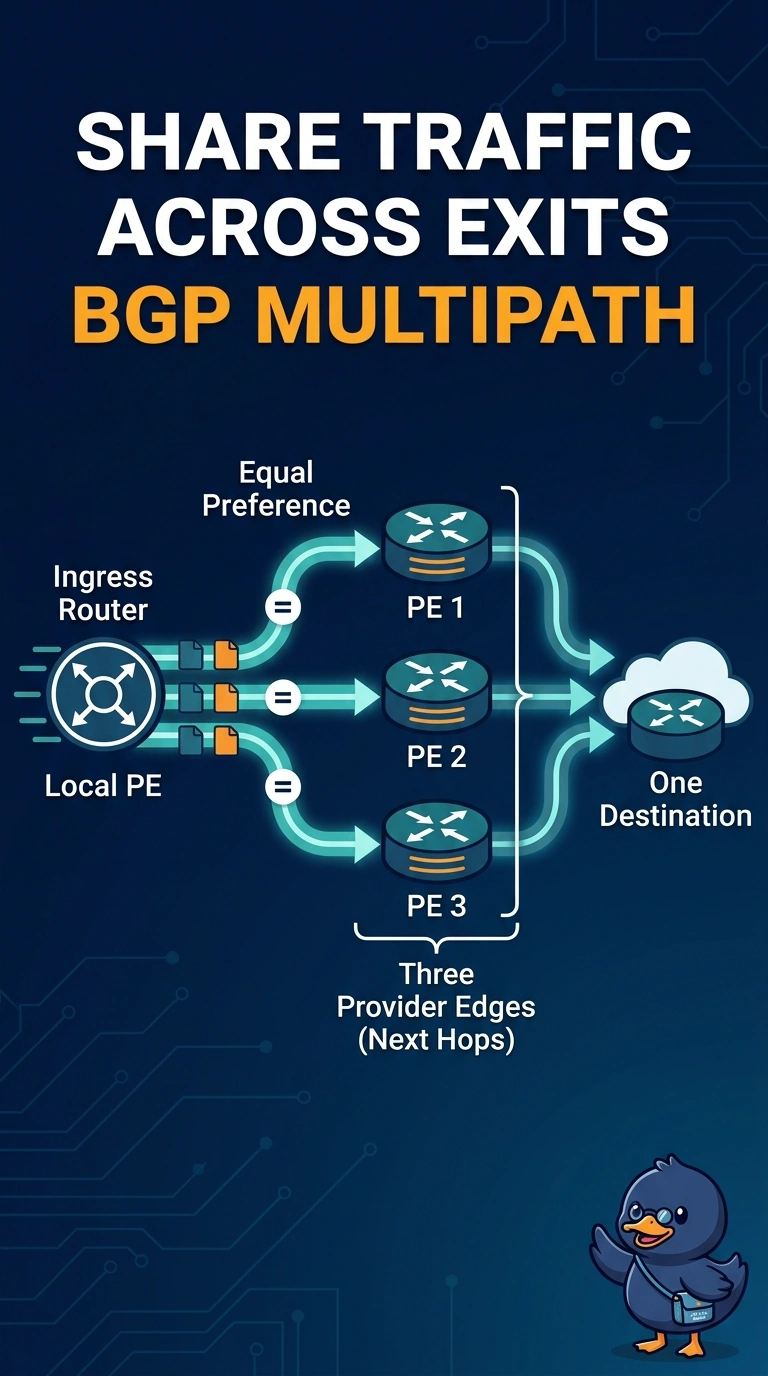
A cloud fabric peers BGP with three provider edges that advertise one destination at equal preference. Traffic for that destination should use all three exits. The three BGP paths meet the platform’s multipath eligibility rules, and the forwarding platform supports at least three paths. Which forwarding design fits?
Select an answer to reveal the explanation.
Short Explanation
Three open checkout lanes help only when the store lets people use every lane. You install BGP multipath so the fabric keeps all three equal BGP next hops. A single static default, OSPF equal-cost paths, and IS-IS equal-cost paths match different routing designs.
Full Explanation
Equal-cost multipath keeps more than one next hop active for the same destination. The fabric already learns that destination from three BGP peers at equal preference, so BGP multipath is what installs all three exits. Configure the address family for at least three eligible paths; equal link cost or preference alone is insufficient. One static default is a single next hop, not multipath. OSPF or IS-IS equal-cost forwarding would apply if those protocols had learned the exits. One static default route that forwards unknown destinations toward a single provider edge is the wrong fit because it installs a single next hop for unknown destinations and leaves the other two exits unused. OSPF equal-cost multipath across provider edges that advertise the destination in OSPF is the wrong fit because it balances traffic across OSPF next hops, and these three exits are learned from BGP peers. IS-IS equal-cost multipath across provider edges that advertise the destination in IS-IS is the wrong fit because it balances traffic across IS-IS next hops, and these three exits are learned from BGP peers. Exam caveat: One static default is not ECMP. Operational check: Confirm the destination shows three BGP next hops and that traffic uses all three exits.