
Two canyon weather stations extend one VLAN with EVPN and VXLAN. The underlay between the leaves still pings, and one leaf never learns remote MAC addresses for that VNI. Where should the operator look?
Select an answer to reveal the explanation.
Short Explanation
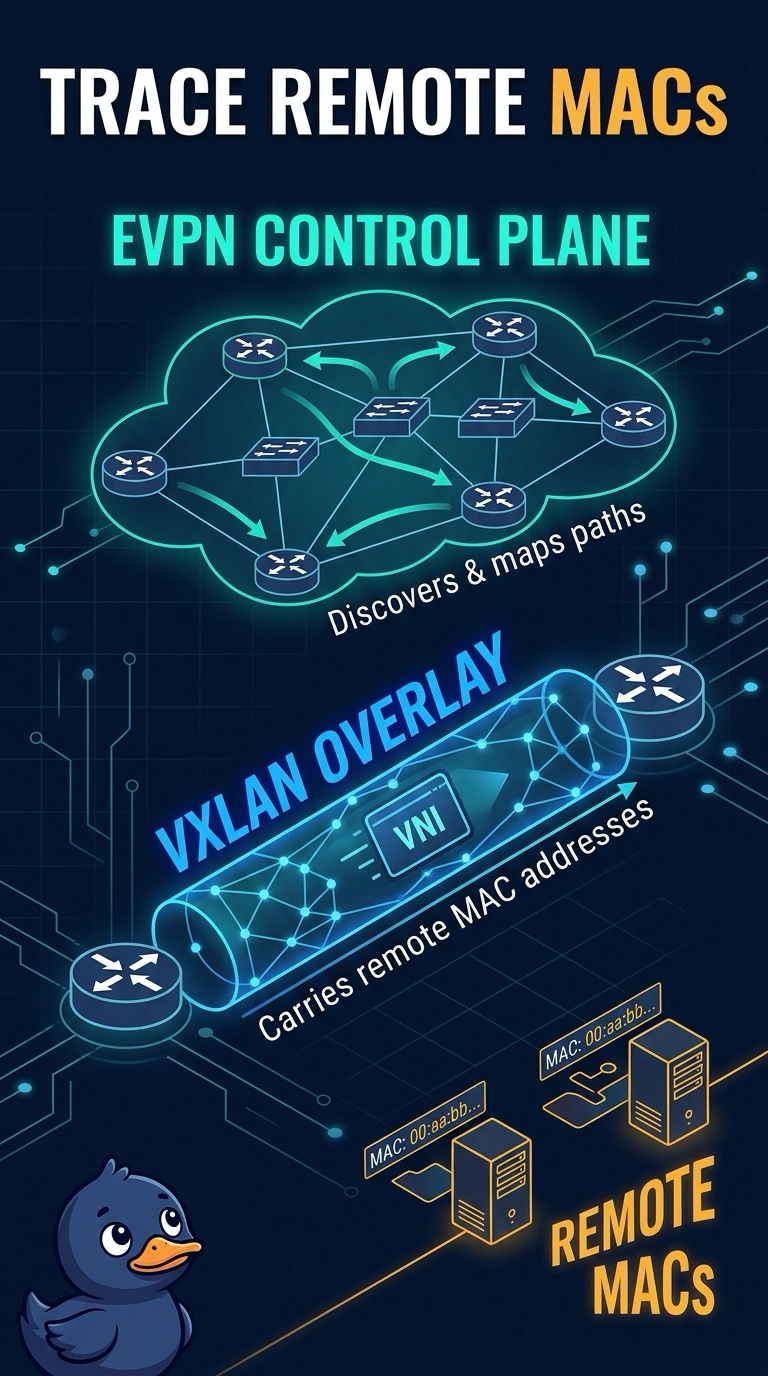
Like a missing road sign on a highway you still drive, MP-BGP EVPN Type 2 routes advertise remote MAC reachability. VXLAN carries the Ethernet data plane. Check local learning, advertisement, route-target import, and VNI mapping.
Full Explanation
MP-BGP EVPN Type 2 routes advertise remote MAC reachability. VXLAN carries the Ethernet data plane. Check local learning, advertisement, route-target import, and VNI mapping. The underlay between the canyon leaves still pings, and one leaf never learns remote MAC addresses for that VNI. The operator looks at the EVPN control plane and the VXLAN overlay. There is no segment-routed MPLS core between the stations. The design is not an ACI fabric. The VLAN is not a pseudowire. The EVPN control plane and VXLAN overlay that should carry those remote MAC addresses is the design that meets this requirement. EVPN over a segment-routed MPLS core that these two stations do not use is the wrong fit because these stations are not joined by a segment-routed MPLS core, so that transport is not where the MAC is missing. An ACI contract inside a policy fabric this weather design does not run is the wrong fit because this design is not an ACI fabric, so a contract in that fabric is not the missing remote MAC. A pseudowire for a point-to-point service this extended VLAN does not use is the wrong fit because the service is an extended VLAN carried by EVPN and VXLAN, not a point-to-point pseudowire. Exam caveat: Look at EVPN and VXLAN while that overlay is what extends the VLAN, and an underlay ping does not prove the VNI is programmed on both leaves. Operational check: Confirm the remote MAC addresses appear once that VNI is present on both leaves, and that the underlay ping stays up the whole time during the test.