
A tenant needs its own subnets and a controlled path out of the cloud, separate from other tenants and from the provider underlay. Which construct fits?
Select an answer to reveal the explanation.
Short Explanation
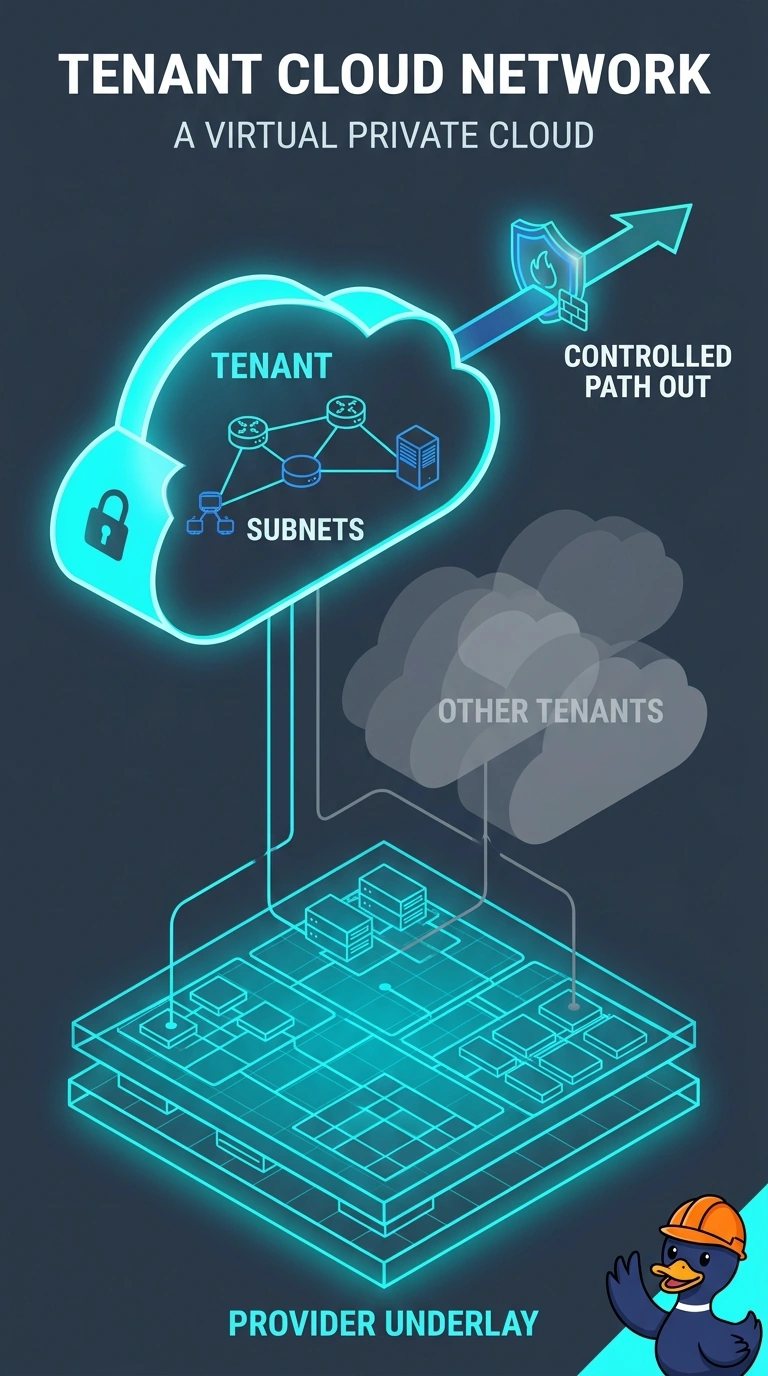
An apartment with its own rooms and a locked front door is not the building service corridor. You give the tenant a virtual private cloud when it needs its own subnets and a controlled exit. The provider underlay, one flat VLAN for everyone, and a meet-me room are different constructs.
Full Explanation
A virtual private cloud is the tenant routed network inside the cloud, with its own subnets and a controlled path out. It is not the provider underlay that carries many tenants, and it is not one flat VLAN stretched to everyone. A meet-me room is where cross-connects land. It is not the tenant routing table. The tenant owns the subnets and the exit, which the shared underlay does not give to one tenant. A virtual private cloud that gives the tenant its own subnets and a controlled path out is the design that meets this requirement. The provider underlay that carries many tenants across the shared transport fabric of the cloud is the wrong fit because it is the shared fabric under many tenants, not one tenant routed network with its own subnets. One flat VLAN stretched across every tenant as a single shared broadcast domain is the wrong fit because it places every tenant in one broadcast domain and gives no separate subnets or controlled exit. A carrier-neutral meet-me room used for cross-connects between carriers and cloud on-ramps is the wrong fit because it is a physical room for carrier cross-connects, not a routed tenant network inside the cloud. Exam caveat: A virtual private cloud is not the provider underlay, and it is not one VLAN stretched everywhere. Isolation here is routed and segmented, with an explicit path out. Operational check: Confirm the tenant routing table in the cloud shows its own subnets and a controlled egress, separate from the provider underlay and from other tenants.