
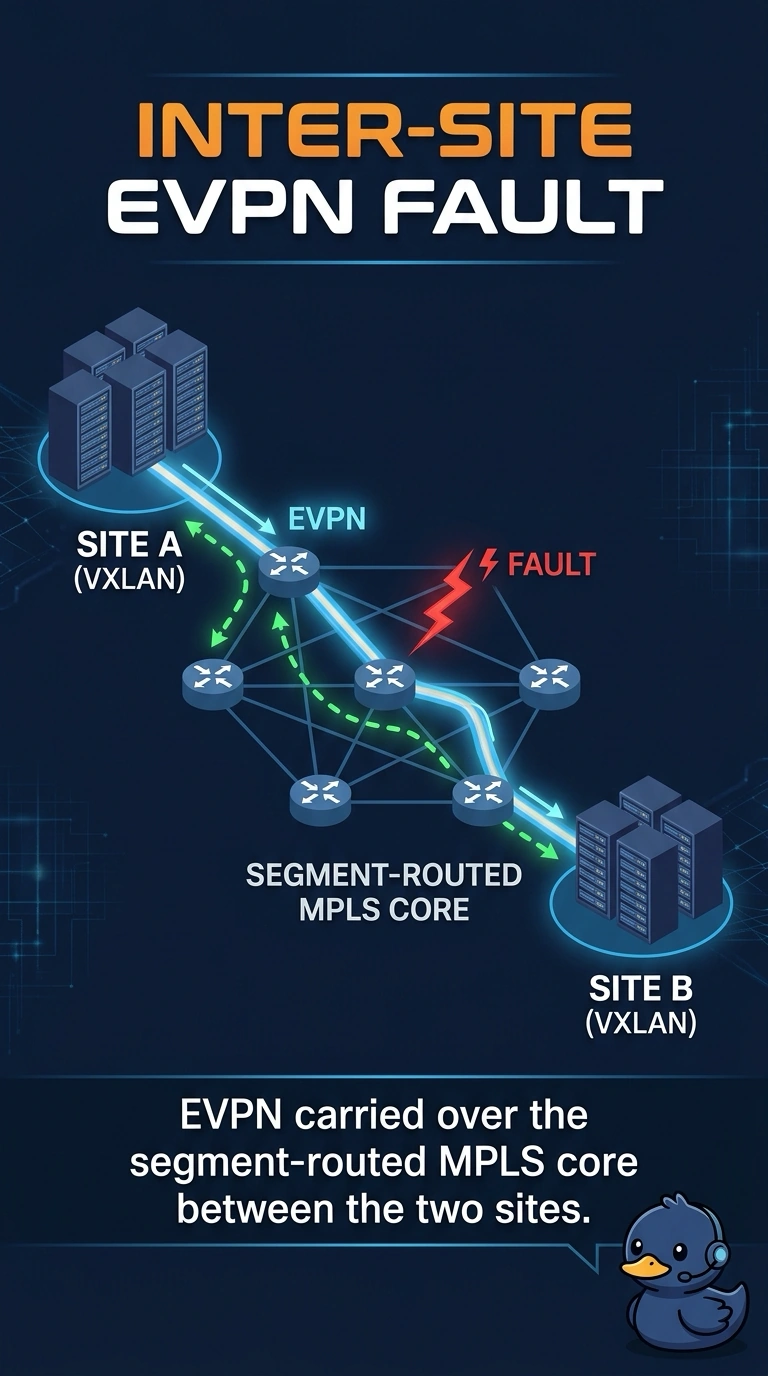
Each data center extends local segments with VXLAN, and EVPN between the sites rides a segment-routed MPLS core. Local tunnel endpoints still ping inside one site, but routes to the other site vanish when a core path fails. Where is the fault?
Select an answer to reveal the explanation.
Short Explanation
You already proved your local VXLAN is up when your endpoints still ping. When those remote routes vanish, verify MP-BGP EVPN peering, route targets and next-hop reachability, then check the separate SR-MPLS forwarding path.
Full Explanation
Inside each site VXLAN still forwards and local tunnel endpoints still ping, so the local overlay is proven up and does not explain missing inter-site routes. Between sites EVPN is carried over the segment-routed MPLS core, so loss of remote routes when a core path fails points to that inter-site control and transport path. Verify MP-BGP EVPN peering and route exchange, including route targets and next-hop reachability. If remote routes are present, check the separate SR-MPLS forwarding path and label stack. Local switching does not identify the cause of an absent remote route. In EVPN carried over the segment-routed MPLS core between the two sites is the design that meets this requirement because it separates EVPN route exchange from SR-MPLS label-switched forwarding. In the local VXLAN tunnels that still forward traffic inside each site is the wrong fit because reachable local VTEPs prove intra-site encapsulation while inter-site EVPN routes are withdrawn. In an application policy contract on a fabric this interconnect does not use is the wrong fit because a contract from an unused fabric model has no role in MP-BGP route-target import or core label reachability. In a pseudowire that is not the encapsulation tying these two sites together is the wrong fit because point-to-point emulation does not carry this EVPN control plane over SR-MPLS.