
Airline crew apps in one city hairpin through a carrier-neutral building across the country, where their only cloud cross-connect sits. A cloud-edge facility is already in their city. Which attachment shortens the path?
Select an answer to reveal the explanation.
Short Explanation
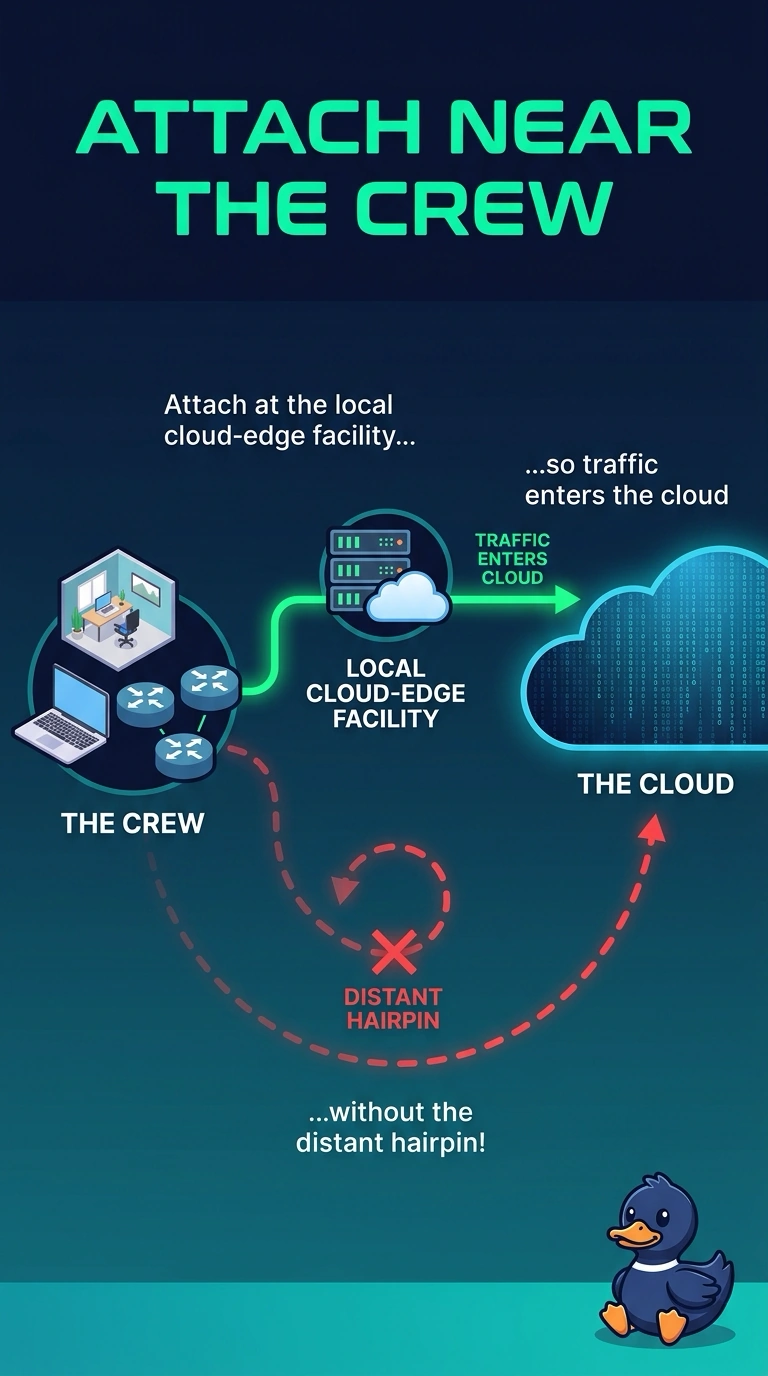
You can shorten the route by using the cloud door already in your city. Attach the airline at the local cloud-edge facility so your crew traffic avoids the distant hairpin. Another cross-connect in the distant neutral building, treating the local edge building as a region, or connecting to an unrelated carrier cage without a cloud on-ramp won’t provide that cloud entry.
Full Explanation
A cloud-edge facility can shorten the path into a cloud when users are far from the only meet-me cross-connect. Because the local edge site is already in the airline’s city, attaching there lets crew traffic enter the cloud without hairpinning through the distant neutral building. Another cross-connect in that distant building, even beside the one already in use, preserves the hairpin and does not use the local cloud-edge facility. Treating the local cloud-edge building as a cloud region and launching a region inside it misunderstands the facility’s role: it is a shorter door into the cloud, not a region whose control plane you launch locally. A cross-connect to an unrelated carrier cage in the distant building with no cloud on-ramp provides a carrier handoff, not the shorter cloud entry this traffic needs. The local cloud-edge attachment therefore meets the requirement. Exam caveat: A cage-to-cage cross-connect makes sense when the destination is another provider already in the same building, not when the goal is a shorter cloud on-ramp. Practical check: Trace the crew traffic and confirm that it enters at the local cloud-edge facility rather than hairpinning through the distant neutral building, then compare latency.