
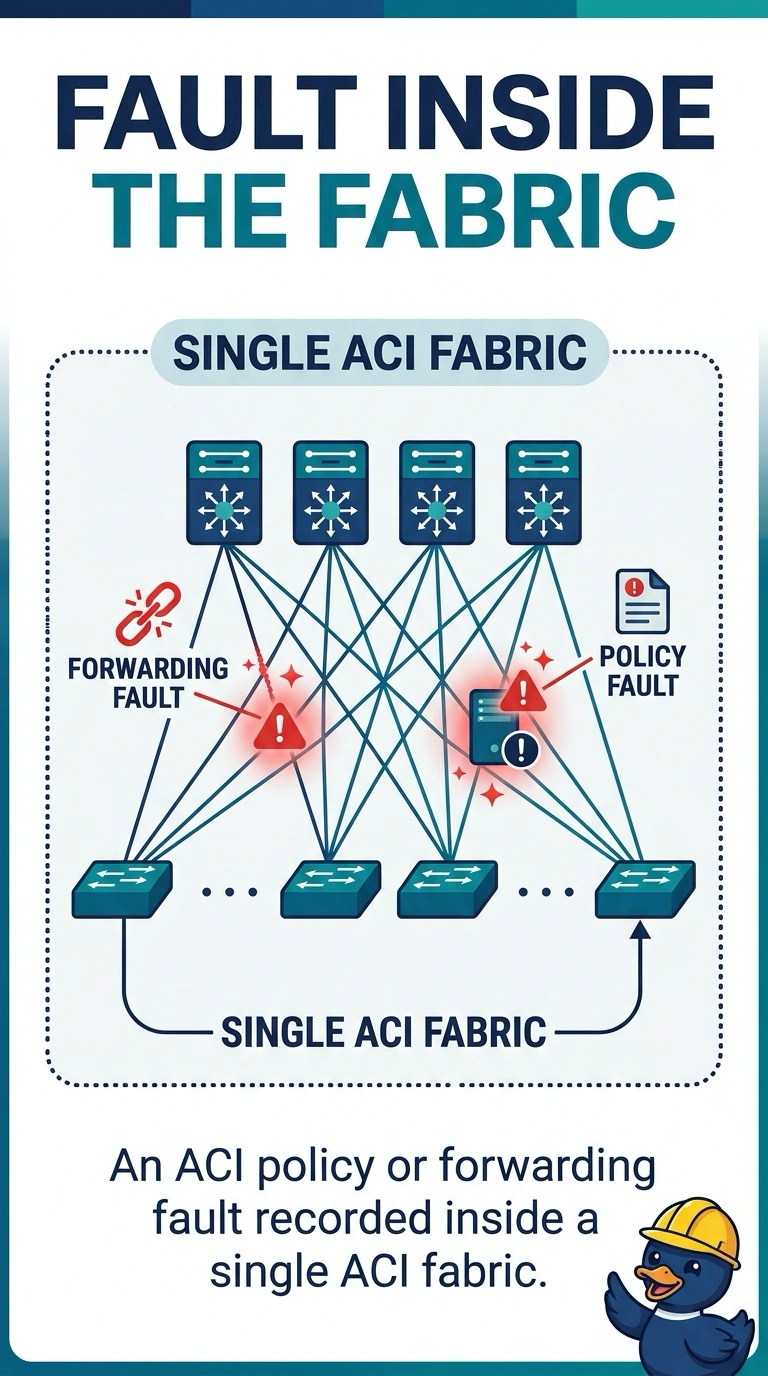
Inside one factory ACI fabric, endpoints that policy should permit cannot reach each other. The path has no data-center interconnect overlay and no pseudowire. Where does the fault belong?
Select an answer to reveal the explanation.
Short Explanation
The doors that fail are inside one building, and there is no highway segment in the story at all. You treat this as an ACI policy or forwarding fault in that fabric. EVPN VXLAN, EVPN over segment routing, and a pseudowire are real tools on other paths, and none of them is present between these endpoints.
Full Explanation
ACI faults are policy or forwarding faults inside the ACI fabric. EVPN with VXLAN is an overlay used to extend Layer 2 or Layer 3 across a data-center fabric boundary. EVPN over segment routing carries that control plane across a segment-routed core. A pseudowire is a point-to-point emulation. None of those three encapsulations is in this path. The drop stays inside this one fabric. An ACI policy or forwarding fault recorded inside that single factory fabric is the design that meets this requirement. An EVPN VXLAN fault on a data-center interconnect that is not in this path is the wrong fit because EVPN with VXLAN would be the overlay on a data-center interconnect, and this path has no such interconnect. An EVPN fault over segment routing on a core that these endpoints do not cross is the wrong fit because EVPN over segment routing belongs on a segment-routed core, and these endpoints do not cross one. A failed point-to-point pseudowire stretched between the two factory endpoints is the wrong fit because a pseudowire is a point-to-point emulation, and the path between these endpoints has no pseudowire. Exam caveat: Do not assign a data-center interconnect encapsulation to a fault that stays inside one ACI fabric. Name the encapsulation that is actually in the path. Operational check: Compare the contracts on the two endpoints and confirm the drop is enforced by this ACI fabric with no interconnect overlay in the full trace.