
Players in one metro reach a distant cloud region by hairpinning across the country. A carrier-neutral building in that metro can host a closer cloud termination. What should the design add?
Select an answer to reveal the explanation.
Short Explanation
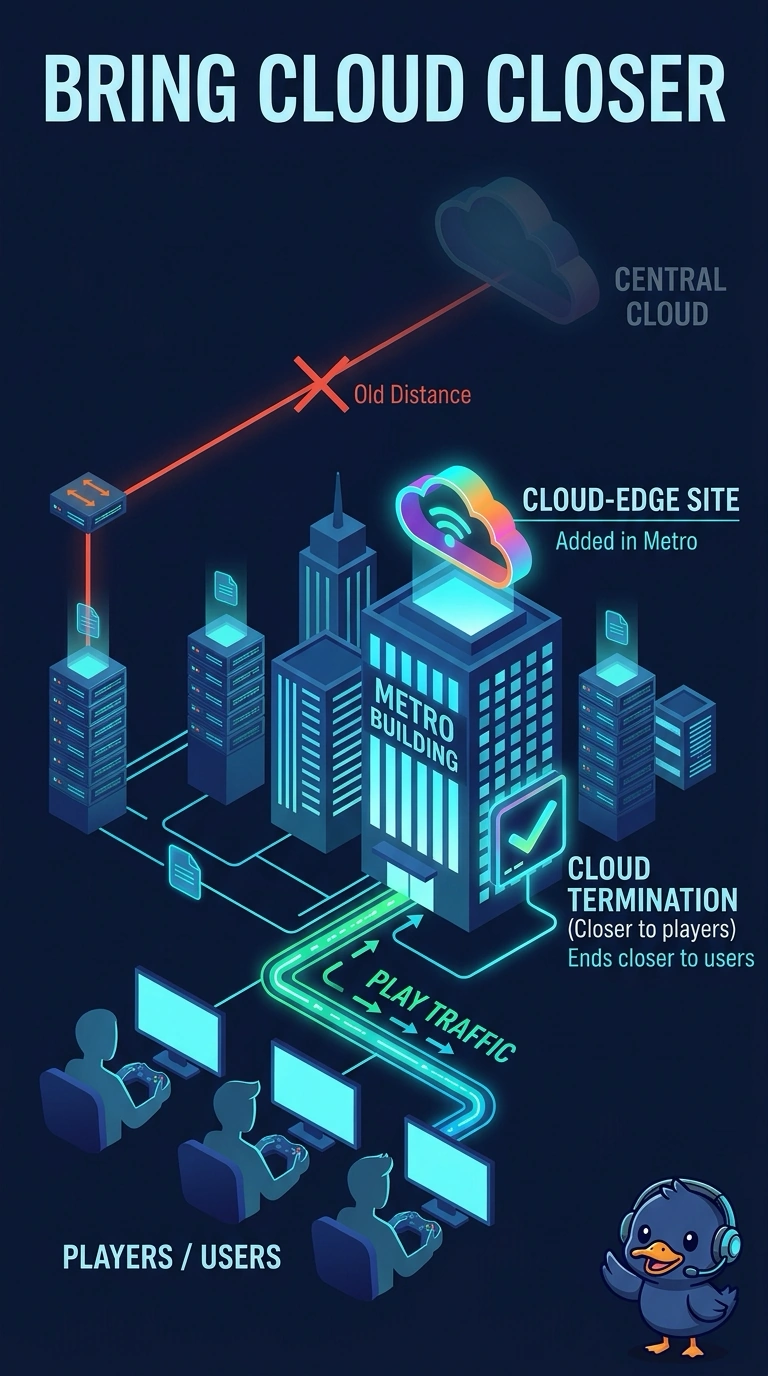
A neighborhood window beats a drive across the country for a package you want nearby, so you use a cloud-edge site in that metro building. Place the required application or processing capacity at a supported nearby edge location and verify the end-to-end path. A local cross-connect alone can still carry traffic to the distant region.
Full Explanation
A cloud-edge site in that metro building gives play traffic a closer cloud termination so it does not have to hairpin to the distant region. Place the required application or processing capacity at a supported nearby edge location and verify the end-to-end path. A local cross-connect alone can still carry traffic to the distant region. The carrier-neutral building remains a facility, and a termination there does not make that building a region. A cloud-edge site in that metro building so play traffic ends closer to the users is the design that meets this requirement. A rename of the carrier-neutral building so it counts as a full cloud region is the wrong fit because renaming does not create a cloud termination, and the building is not itself a region. A cross-connect only to an unrelated carrier cage with no cloud termination is the wrong fit because it does not terminate the cloud path in this metro and can still leave traffic bound for the distant region. A longer backhaul that keeps every player attached only to the distant region is the wrong fit because keeping the long backhaul leaves the hairpin the design was asked to remove. Exam caveat: A cloud-edge site shortens the path only when the workload uses the edge and the path is verified. Operational check: Compare player latency to the metro cloud-edge termination with latency to the distant region.