
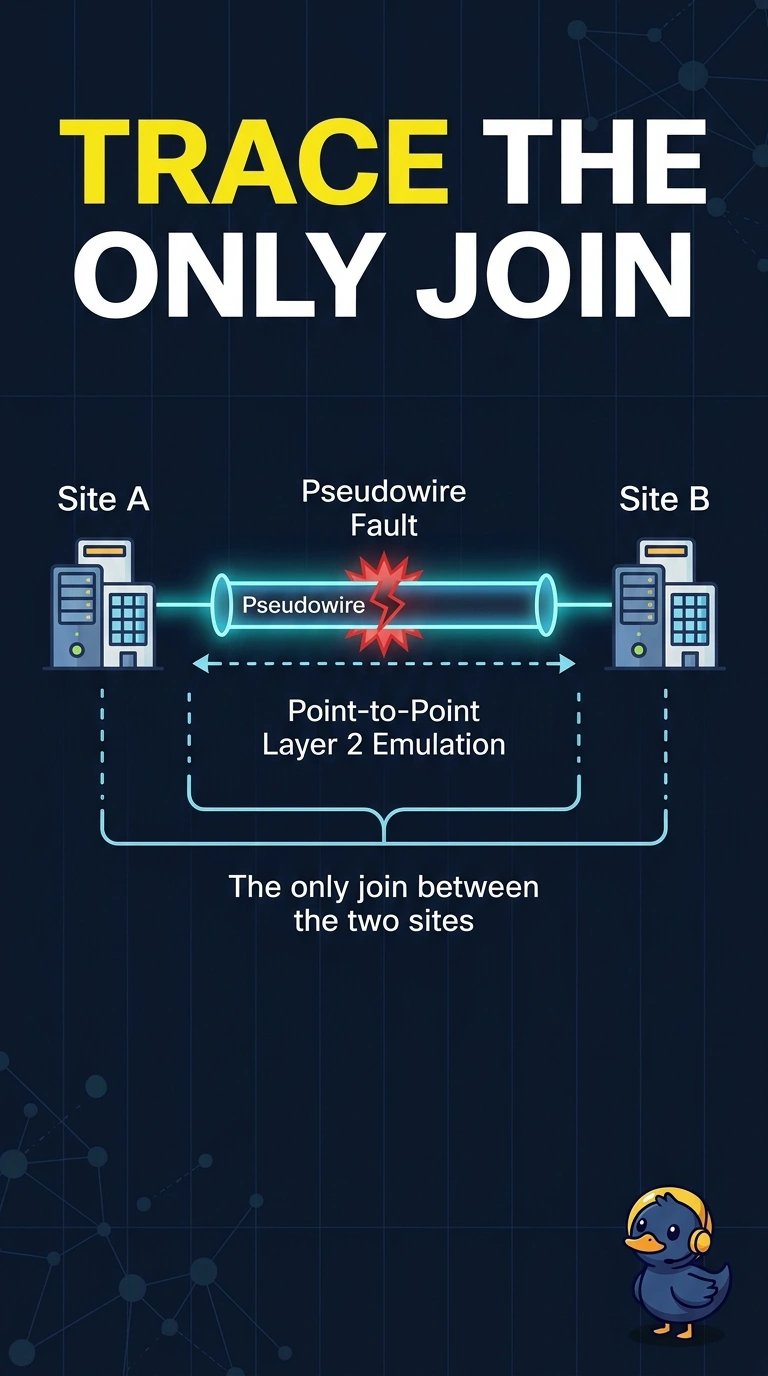
Two small sites are joined only by an Ethernet service. The provider provisions this Ethernet service using a pseudowire. This service uses a point-to-point pseudowire. Hosts on that emulation can no longer reach each other. Which fault matches the path?
Select an answer to reveal the explanation.
Short Explanation
If the only bridge is a single plank, you inspect that plank. This service uses a point-to-point pseudowire, so you treat the outage as a pseudowire fault because nothing else joins the sites. EVPN with VXLAN, EVPN over segment routing, and an ACI fabric fault describe encapsulations that are not in this path.
Full Explanation
This service uses a point-to-point pseudowire. When that emulation is the only join between the sites and hosts on it cannot reach each other, the fault matches the pseudowire. EVPN with VXLAN extends Layer 2 or Layer 3 across a data-center fabric overlay. EVPN over segment routing carries EVPN across a segment-routed core. An ACI fault is policy or forwarding inside an ACI fabric. Those encapsulations are absent on this path. An EVPN with VXLAN fault is the wrong fit because that overlay is not what joins these two sites. An EVPN over segment-routing fault is the wrong fit because this service uses a point-to-point pseudowire as the site-to-site join, not that transport. An ACI policy or forwarding fault is the wrong fit because this site-to-site path does not traverse that fabric. Exam caveat: A pseudowire fault explains this path only while that emulation is in use, and a later move to EVPN would change the fault model. Operational check: Confirm the join is the pseudowire and EVPN and ACI are absent, then trace that emulation.