
A freight exchange already has a private interconnect into the cloud across a provider core. The new need is to steer flows onto one low-delay core path. What meets that need?
Select an answer to reveal the explanation.
Short Explanation
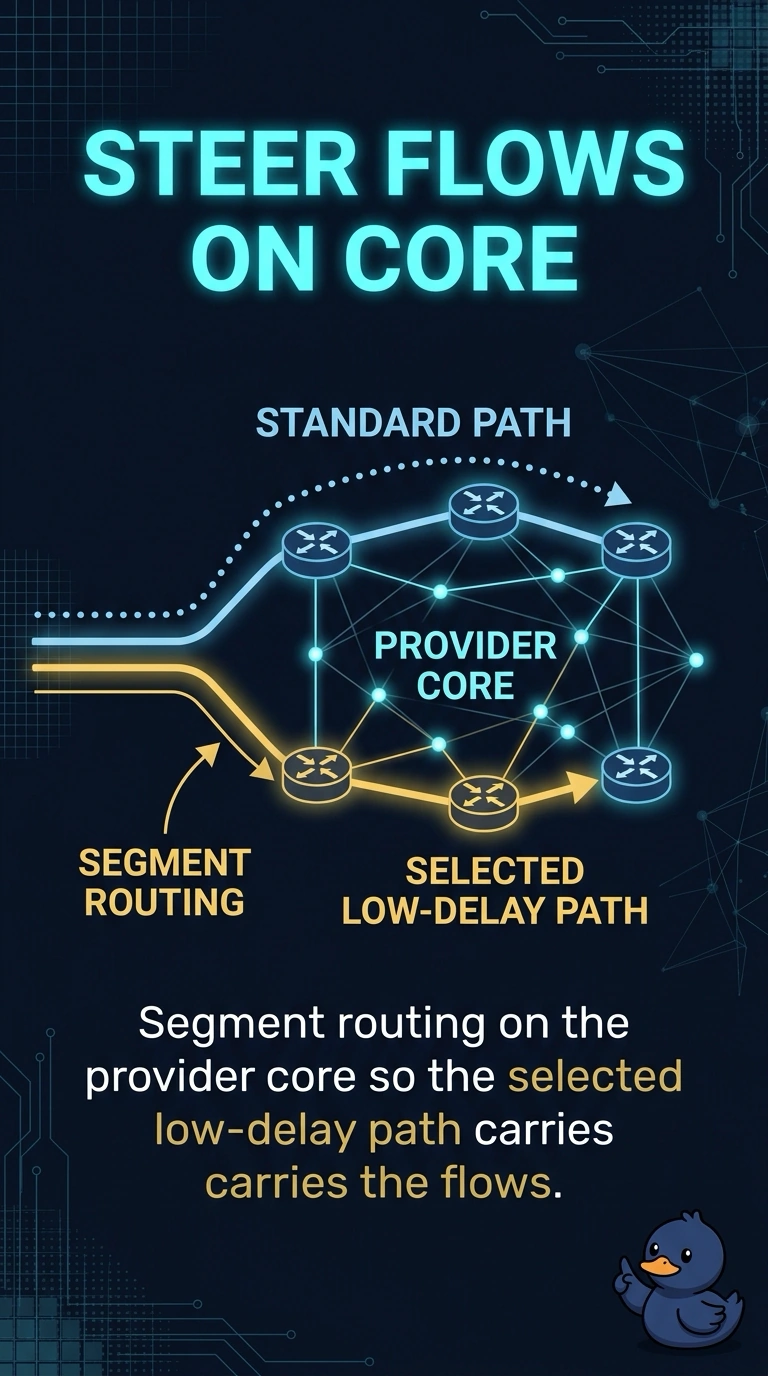
You already have a private road into the yard, and the new request is which lane inside the yard your trucks use. You steer those flows with segment routing on the provider core. IPsec, a second private interconnect, and GRE add a cipher, another gate, or a wrapper instead of the lane selection you asked for.
Full Explanation
Direct connect or a private interconnect gives a dedicated attachment, which this exchange already has. Segment routing is the provider transport control that can steer flows onto a chosen low-delay path in the core. Use IPsec ESP with encryption wherever policy requires network-layer confidentiality, including on a private circuit. The dedicated attachment itself does not guarantee end-to-end encryption. Segment routing on the provider core so the selected low-delay path carries the flows is the design that meets this requirement. IPsec ESP with encryption added on the private interconnect for confidentiality is the wrong fit because it adds confidentiality, and this requirement needs a chosen path rather than encryption. A second private interconnect into the same cloud for an attachment that already exists is the wrong fit because it only adds facility attachment the exchange already has. A GRE tunnel that encapsulates the flows without steering the provider core is the wrong fit because GRE encapsulates packets and does not steer the provider core and is not encryption. Exam caveat: A private interconnect does not steer a chosen path; add segment routing for steering, or IPsec when confidentiality is the actual gap.