
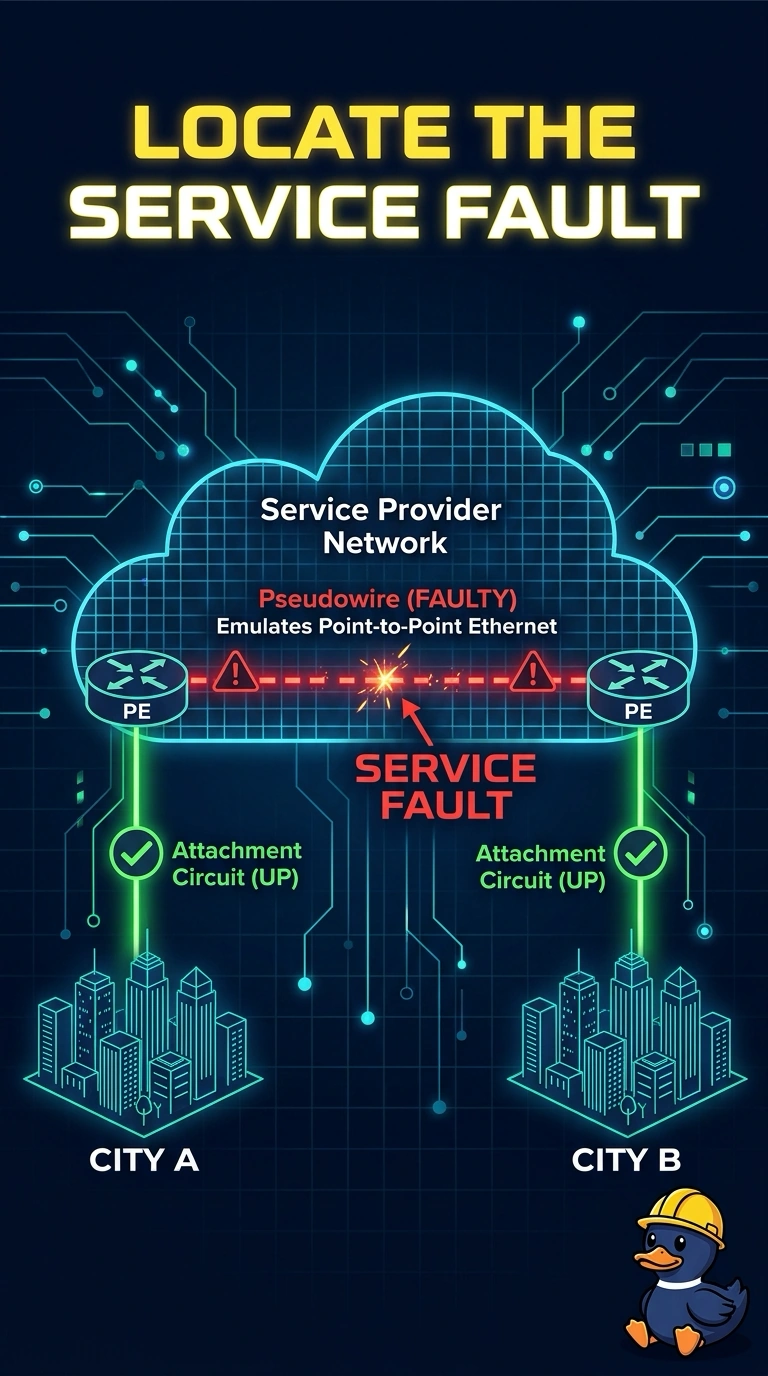
A wholesale customer has one point-to-point Ethernet service between two cities. The attachment circuits are up, but the emulated circuit between the provider edges is down. The service is a pseudowire, not an EVPN fabric. Where is the fault?
Select an answer to reveal the explanation.
Short Explanation
You can treat this like a private driveway between two houses, not the city grid. Since the attachment circuits are up and the emulated circuit is down, focus on the pseudowire; EVPN/VXLAN, EVPN over segment routing, and ACI are not in this path.
Full Explanation
A pseudowire provides a point-to-point emulation of Ethernet between provider edges. Because the attachment circuits are up while the emulated circuit is down, the fault to investigate is the pseudowire that carries this service between the edges. The EVPN and VXLAN overlay of a data-center fabric is not the answer: EVPN with VXLAN extends a data-center fabric, but this customer has a single pseudowire, not an EVPN fabric. An EVPN control plane carried on a segment-routed core is also not the answer: it describes a different design and control plane, rather than the point-to-point emulation used here. An ACI policy or forwarding fault inside a fabric does not fit either, because the stated service path is a pseudowire between provider edges, not an ACI fabric. Exam caveat: If the same cities also had an EVPN fabric, that would be a separate service; do not attribute this pseudowire symptom to that overlay. Practical check: On both provider edges, verify that the attachment circuits are up and the pseudowire status is down, and confirm that no EVPN or ACI object is in the customer forwarding path.